John Ternus Takes Over Apple on September 1. What a Hardware Engineer as CEO Means for AAPL
Tim Cook becomes executive chairman on September 1 and John Ternus becomes CEO. Apple's first transition since 2011, what changes for the stock, and what Thursday's call reveals.
TL;DR
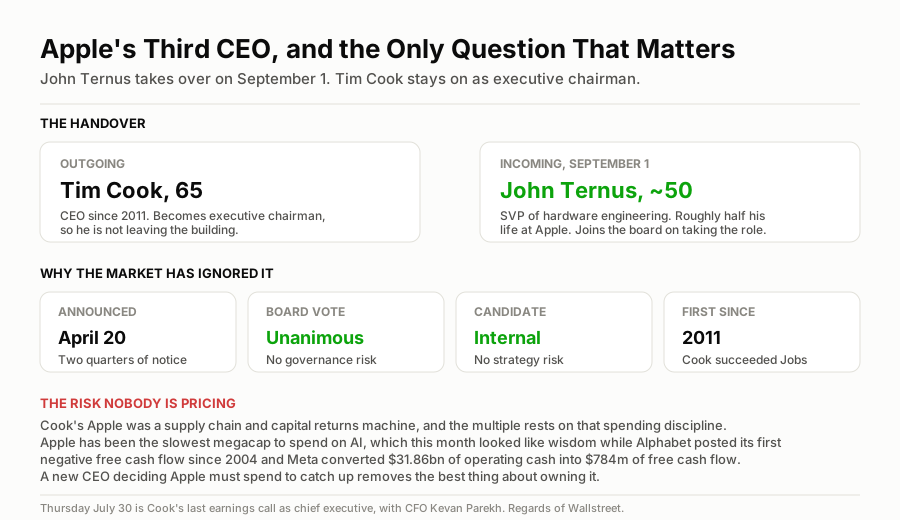
- John Ternus becomes Apple's CEO on September 1, 2026. Tim Cook, 65, becomes executive chairman. The board approved it unanimously and announced it on April 20.
- This is Apple's first CEO transition since 2011, when Cook succeeded Steve Jobs. Only three people have run Apple in the modern era.
- Ternus is about 50, has been senior vice president of hardware engineering, and has spent roughly half his life at Apple, joining four years after graduating from Penn with a mechanical engineering degree. He joins the board when he takes the role.
- The succession is not news, it has been public for three months. What is new is Thursday's earnings call, Cook's last as chief executive, which is the first real read on how the handover is being framed to investors.
- The investment question is narrow and specific: Cook's Apple was a supply chain and capital returns machine that made Services the growth story. Ternus is a product engineer. Nobody knows yet whether that changes capital allocation, and capital allocation is what the multiple rests on.
More on $AAPL: Why Did Apple Stock Drop After Earnings? Services Missed, Then the September Guide Came In Light →
What Is Actually Happening, and When
The facts, cleanly separated from the commentary.
| Element | Detail |
|---|---|
| New CEO | John Ternus, previously SVP of hardware engineering |
| Effective | September 1, 2026 |
| Tim Cook's new role | Executive chairman |
| Announced | April 20, 2026, approved unanimously by the board |
| Board seat | Ternus joins the board on becoming CEO |
| Interim | Cook stays CEO through the summer, working on the handover |
Two details in that table deserve more weight than they usually get.
Cook is not leaving. Executive chairman is an active role, not a retirement plaque. The most disruptive version of a CEO transition, where the outgoing leader departs entirely and institutional knowledge walks out, is not what is happening. For a company whose competitive advantage is substantially a supply chain Cook built over 25 years, that continuity is worth something real.
The process was long and the vote was unanimous. Apple described a thoughtful long-term succession process, and the board was not split. Contested successions are where governance risk lives. This is the opposite shape.
The Board
Apple's third CEO of the modern era, and the first one who is an engineer rather than an operator.
Why the Market Has Barely Reacted
Because it has had three months, and because Apple went out of its way to make this boring.
Announcing in April for a September handover gives investors two full quarters to reprice. Naming an internal candidate with twenty-plus years of tenure removes strategy risk. Keeping Cook as executive chairman removes execution risk. Getting a unanimous board vote removes governance risk. Every lever available to make a CEO transition uneventful was pulled.
That is genuinely good management of a genuinely difficult moment, and it is why this is not currently a stock story.
It also means the real information has not arrived yet. Succession announcements are choreographed. Earnings calls are less so, and Thursday is Cook's last as CEO, with CFO Kevan Parekh alongside him. Our full setup for the print is in the Apple earnings preview.
The Question That Actually Matters
Not "is Ternus good." He has run hardware engineering for a company that ships the most complex consumer products on earth, at scale, on schedule. The competence question is settled.
The question is what an engineer-led Apple does with the money.
Consider what Cook's Apple actually was, stripped of the mythology. It was not primarily a product company for the last decade. It was a supply chain and capital allocation machine. Cook's genius was operational: build an unmatched manufacturing network, extract enormous margin from it, and return staggering amounts of cash to shareholders while growing Services into the highest-margin business Apple has. Services went from $26.6 billion to $30.9 billion year over year in the most recent quarter, and it is the reason the multiple survived flat iPhone cycles.
An engineer running that machine could take it in three directions.
Continuity. Ternus runs the Cook playbook, keeps the buyback, keeps Services compounding, and Apple looks the same. Most likely near-term, and the market is priced for it.
More hardware ambition. A hardware engineer with the CEO's chair and Apple's balance sheet may want to build things: new categories, silicon, devices. Product ambition consumes capital that currently goes to buybacks. That could be excellent for the business in 2032 and awkward for the share count in 2027.
An AI catch-up push. This is the live strategic gap. Apple has been the slowest megacap to spend on AI infrastructure, which in the current market has been an advantage: while Alphabet posted its first negative free cash flow since its 2004 IPO and Meta converted $31.86 billion of operating cash flow into $784 million of free cash flow, Apple's discipline looked like wisdom. If a new CEO decides Apple must spend to compete, the single best thing about owning Apple in 2026 goes away.
That third scenario is the actual risk, and nobody is pricing it.
What to Listen For on Thursday
Cook's last call is not a formality. Four things to listen for, in order of usefulness.
- Any capital allocation language that sounds different. Changes in tone about buyback pace, capex or "investing for the future" matter far more than the quarter.
- Whether Ternus speaks, and about what. A hardware chief taking analyst questions on strategy is a preview of the next decade.
- Gross margin guidance for the September quarter. Guided at 47.5% to 48.5%, and now under real pressure from memory and component costs that have already hit Qualcomm. This is the number that decides the stock this week regardless of who is CEO. Our screen of who else is exposed is in which stocks get hit next by memory costs.
- AI commentary, and how defensive it sounds. Confidence in the current approach is bullish for cash flow. Urgency is not.
Does This Change the Case for Owning Apple?
Not yet, and be honest about the word "yet."
The bull case is unchanged. A unanimous internal succession, a twenty-year veteran, the outgoing CEO staying as executive chairman, and a business printing $108.9 billion of expected quarterly revenue with Services compounding at high margin. Nothing about the machine has broken and nothing has been announced that alters it.
The bear case is that leadership transitions are where capital allocation regimes change, and Apple's capital allocation regime is the entire investment case. You are not buying Apple for revenue growth. You are buying a durable franchise that converts profit into buybacks and dividends with unusual discipline. That discipline is a choice, and choices belong to whoever is in the chair.
Our read: hold what you own and do not trade the succession. It is well-managed, well-telegraphed and close to a non-event for the next several quarters. Set a reminder for the first earnings call Ternus runs, likely covering the September quarter, because that is where a new CEO signals priorities. Until then, Apple is priced on the memory cost question and the discount rate, not on who signs the letters.
What would change our view, in either direction: a materially larger AI capex commitment would make us more cautious, because it would put Apple on the same treadmill that has punished Alphabet and Meta all month. A reaffirmed buyback with unchanged spending discipline under a new CEO would make the stock more attractive, not less, because it would prove the regime survives the person.
The One-Line Read
John Ternus becomes Apple's CEO on September 1 with Tim Cook staying on as executive chairman, and Apple has engineered the transition to be as uneventful as possible, which is why the stock has ignored it: the thing worth watching is not competence but capital allocation, because Apple's multiple rests on spending discipline that a hardware engineer with a fresh mandate and an AI gap might reasonably choose to abandon.
Next up:Fed decision, Tuesday →
More on $AAPL
$AAPL · 2026-07-30
Why Did Apple Stock Drop After Earnings? Services Missed, Then the September Guide Came In Light
$AAPL · 2026-07-29
Apple Reports Tonight: $108.9 Billion Expected, iPhone Up 23%, and Tim Cook's Last Earnings Call as CEO
$AAPL · 2026-07-27
Apple Options Before Earnings: $442 Million in Calls, a 4% Implied Move, and What It Actually Predicts
Updated Every Saturday
The Week Ahead
Every earnings date, Fed event and setup for the current trading week, on one page.
Refreshed Weekly
Earnings Calendar
Who reports next, when, and what consensus and the whisper expect.
The Week-Ahead Brief
Don’t miss next week’s setups. Get the Sunday brief.
Latest issue, Sep 7“Week ahead in the stock market...”
Every Sunday: next week’s earnings dates, Fed days and the trades worth watching, from the same desk that writes the week-ahead hub. Free, built for retail investors.