Apple Reports Tonight: $108.9 Billion Expected, iPhone Up 23%, and Tim Cook's Last Earnings Call as CEO
Apple reports fiscal Q3 after the close July 30, with revenue of $108.9B and EPS of $1.89 expected. The call at 5pm ET is Tim Cook's last as CEO. What actually decides the reaction.
TL;DR
- Apple reports fiscal Q3 2026 after the close on Thursday July 30, with the conference call at 5:00pm ET / 2:00pm PT. It is Tim Cook's final earnings call as chief executive, alongside CFO Kevan Parekh.
- Consensus across roughly 27 to 31 analysts: revenue of about $108.9 billion, up 16% from $94.0 billion, and diluted EPS of $1.89, up about 20% from $1.57.
- iPhone revenue is modelled up 23% to $54.8 billion. Services came in at $30.9 billion last quarter, up from $26.6 billion a year earlier.
- Apple guided the June quarter to 14% to 17% revenue growth and gross margin of 47.5% to 48.5%. Consensus sits inside the revenue range, which means the bar is management's own.
- Apple has beaten EPS in each of the last four quarters. The risk is not the beat. It is the gross margin line, because memory prices are now a visible cost problem across the industry, and Apple buys a great deal of memory.
More on $AAPL: Why Did Apple Stock Drop After Earnings? Services Missed, Then the September Guide Came In Light →
What Time Does Apple Report Earnings?
After the close on Thursday, July 30, with the call at 5:00pm ET.
That call is the unusual part. Tim Cook is stepping down as CEO, and this is his last quarterly call in the role. Expect two things: unusually direct questions about succession and strategy, and unusually careful answers. In a normal quarter the call is a formality that moves the stock less than the release. Tonight it can move it more.
Apple also reports the same evening as Amazon, which splits attention and tends to make after-hours pricing erratic in both. And it lands after a morning in which core PCE and the first estimate of Q2 GDP print at 8:30am. Our full run of the day is in the July 30 what-to-watch guide.
The Board
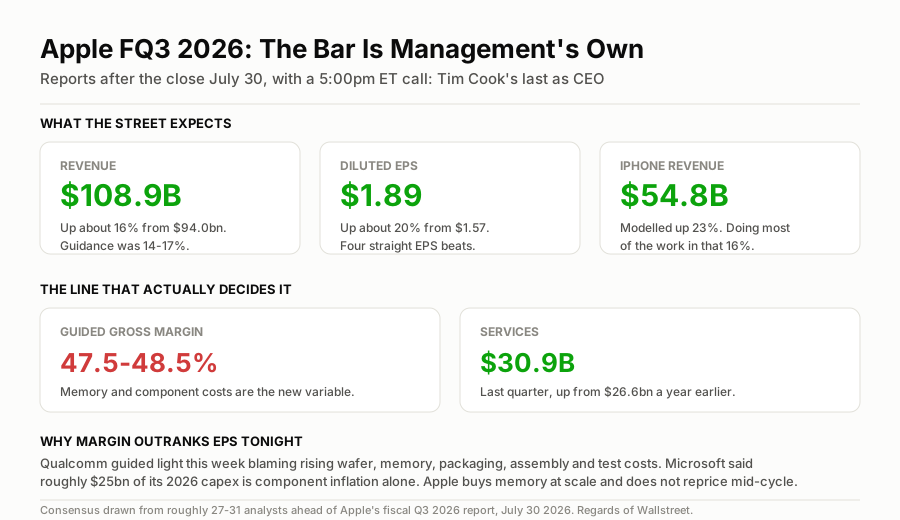
Consensus sits inside Apple's own guidance range. That makes the margin line the interesting one.
What the Street Expects
| Line | Consensus | Comparison |
|---|---|---|
| Revenue | ~$108.9B | up about 16% from $94.0B |
| Diluted EPS | $1.89 | up about 20% from $1.57 |
| iPhone revenue | ~$54.8B | modelled up 23% |
| Services | $30.9B last quarter | from $26.6B a year earlier |
And Apple's own guidance, which is the bar the consensus was built around:
| Apple guided | Range |
|---|---|
| Revenue growth | 14% to 17% |
| Gross margin | 47.5% to 48.5% |
Two observations before the numbers arrive.
Consensus is inside the guidance range. Apple guided 14% to 17% growth; 16% is the middle. When the street parks itself in the centre of management's own range, the headline is close to pre-agreed. Beating it is normal and worth very little.
iPhone up 23% is a genuinely large number for a mature product. Apple's iPhone base is famously price-inelastic, which is why the street is comfortable modelling growth like that. It is also the number with the most room to disappoint, because it is doing most of the work in that 16%.
The Line That Actually Decides It
Gross margin, guided at 47.5% to 48.5%.
Here is why that band matters more this quarter than in any recent one. Over the last two sessions, memory pricing stopped being a story about memory companies and became a cost line on the buyers.
Qualcomm reported revenue near the high end of guidance and non-GAAP EPS down 20%, then guided next quarter light, explicitly blaming rising wafer fabrication, memory, advanced packaging, assembly and test costs, and said it is raising product prices in response. Microsoft disclosed that roughly $25 billion of its calendar-2026 capital spending is attributable purely to higher component pricing. We covered the mechanism in the Qualcomm breakdown and the supply side in the CXMT explainer.
Apple puts memory in every device it sells, at enormous volume, and it does not raise prices mid-cycle. Which means a memory cost shock shows up in exactly one place: gross margin.
So the hierarchy for tonight is: gross margin first, iPhone second, EPS a distant third. A revenue beat with gross margin at the low end of 47.5% to 48.5%, or guided lower for the September quarter, is a worse outcome than an in-line quarter with margin held. This is the same trap the market has punished all week: Vertiv beat on EPS and lost 13% on one soft line.
China, and the Question This Site Has Been Asking
Our July 16 Apple preview framed the whole print around a single question: what does the rise of Chinese memory manufacturing mean for a company that assembles in China and buys components from Asia?
Three weeks later that question has answers, and they cut both ways.
The bear reading: CXMT's 466% Shanghai IPO debut confirmed China is scaling memory capacity fast. Combined with the broader cost inflation Qualcomm just described, Apple's input costs are going up, and its component supply chain is increasingly concentrated in a jurisdiction that is also a geopolitical risk.
The bull reading: cheaper Chinese memory in 2027 and beyond is good for a buyer of memory. Apple is on the right side of a DRAM price war, eventually. The pain is a timing problem, not a structural one.
Both are true. The timing is what matters for tonight's margin line.
The Bull Case and the Bear Case
Bull case. Four consecutive EPS beats, a guidance range consensus sits comfortably inside, iPhone growing 23% off a price-inelastic base, and Services compounding from $26.6 billion to $30.9 billion year over year, which is the highest-margin revenue Apple has. Services growth is the reason Apple's multiple survives hardware cycles. If margin holds inside the guided band, this is a clean quarter into a market desperate for one.
Bear case. The bar is management's own and the market rewards nobody for clearing it. Memory and component costs are rising industry-wide and Apple is a huge buyer. A CEO transition adds narrative risk to a call that normally carries none. And Apple reports into a tape where the Nasdaq Composite is more than 10% below its record and the 30-year Treasury sits at 5.193%, which is a discount-rate problem that a good iPhone quarter cannot fix.
Our read: expect a beat on revenue and EPS, and do not trade the beat. The reaction will be set by the September-quarter gross margin guide. If it holds 47%-plus, Apple is the defensive megacap this market wants and the stock works. If it guides margin down on component costs, the beat gets ignored exactly as Vertiv's did. Position for the guide, not the print.
The Options Angle
- Implied volatility is elevated into a double megacap print. Buying calls or puts outright means paying event premium and then eating the vol crush even if you get the direction right.
- Apple's realised earnings moves are historically modest for its size. That argues for selling premium, and in a normal quarter it would be the trade. This is not a normal quarter: a CEO's final call plus an unresolved margin question is precisely the setup that produces the surprise premium sellers cannot survive. We just watched that happen to a Coca-Cola premium sale.
- If you hold shares long term, a covered call into elevated pre-earnings volatility is the one structure that is clearly reasonable here.
- Do not hold short-dated premium through both Apple and Amazon on the same evening. Two prints, one expiry, correlated outcomes, and no way to manage the position until Friday.
The One-Line Read
Apple should beat a bar it set itself, with revenue near $108.9 billion and EPS around $1.89, so the reaction will not be decided by either number: watch the September-quarter gross margin guide, because memory and component costs just showed up on Qualcomm's and Microsoft's statements, and Apple buys more memory than either of them.
Next up:Fed decision, Tuesday →
More on $AAPL
$AAPL · 2026-07-30
Why Did Apple Stock Drop After Earnings? Services Missed, Then the September Guide Came In Light
$AAPL · 2026-07-29
John Ternus Takes Over Apple on September 1. What a Hardware Engineer as CEO Means for AAPL
$AAPL · 2026-07-27
Apple Options Before Earnings: $442 Million in Calls, a 4% Implied Move, and What It Actually Predicts
Updated Every Saturday
The Week Ahead
Every earnings date, Fed event and setup for the current trading week, on one page.
Refreshed Weekly
Earnings Calendar
Who reports next, when, and what consensus and the whisper expect.
The Week-Ahead Brief
Don’t miss next week’s setups. Get the Sunday brief.
Latest issue, Sep 7“Week ahead in the stock market...”
Every Sunday: next week’s earnings dates, Fed days and the trades worth watching, from the same desk that writes the week-ahead hub. Free, built for retail investors.