Baidu (BIDU) Earnings Aug 18: AI Passed Search, and the Chip Unit May Be Worth More Than Baidu
Baidu missed Q2 2026 estimates on August 18: revenue in line at $4.62 billion, adjusted EPS well short of consensus, and the stock closed down about 13% as AI growth failed to offset the ad decline.
TL;DR
- Baidu reports Q2 2026 before the US open on Tuesday, August 18, with the call at 8:00am ET, per the company's SEC filing.
- The search business is shrinking fast. Online marketing revenue was RMB 12.6 billion in Q1 2026, down 22% year over year. A year-ago base of RMB 16.2 billion means Baidu could hold last quarter's level exactly flat and still print another 22% decline on Tuesday.
- AI crossed half the business for the first time. AI-powered revenue hit RMB 13.6 billion, up 49%, and 52% of Baidu General Business against 36% a year earlier. AI Cloud Infra alone grew 79%.
- The stock has gone nowhere for it. BIDU closed $104.68 on August 13, near the bottom of a $84.82 to $165.30 52-week range, for a market cap of $35.5 billion.
- The odd part is the chip unit. Kunlunxin was reported in June to be targeting a $50 billion Hong Kong IPO. Baidu's reported 57.67% of that is $28.8 billion, or 81% of Baidu's entire market cap. I do not believe that number, and the reason why is the most useful thing in this preview.
- UPDATE (August 18): the ad line beat, the bottom line missed, and the stock broke its implied move again, to the downside. Revenue was RMB 31.33 billion ($4.62 billion), down 4% year over year and roughly in line with the $4.65 billion consensus. Online marketing revenue fell 19% year over year, actually a smaller decline than Q1's 22%. But adjusted EPS came in around $1.05, badly missing the compiled consensus (aggregators put it anywhere from $1.35 to $1.51, reflecting the GAAP/non-GAAP compilation issue flagged below) and down sharply from the year-ago quarter. GPU Cloud revenue accelerated further, up 283% year over year against Q1's 184%, but capex tripled to $1.69 billion and free cash flow went to negative $1.18 billion, a much steeper burn than Q1's −$470 million. The stock closed down about 13% at $90.87, well past the 5.8% implied move and the third downside break of implied in the name's last nine reports. No Kunlunxin detail was given on the call.
More on $BIDU: Is Baidu (BIDU) a Buy Before Aug 18? $28B of It Is Cash →
The Board
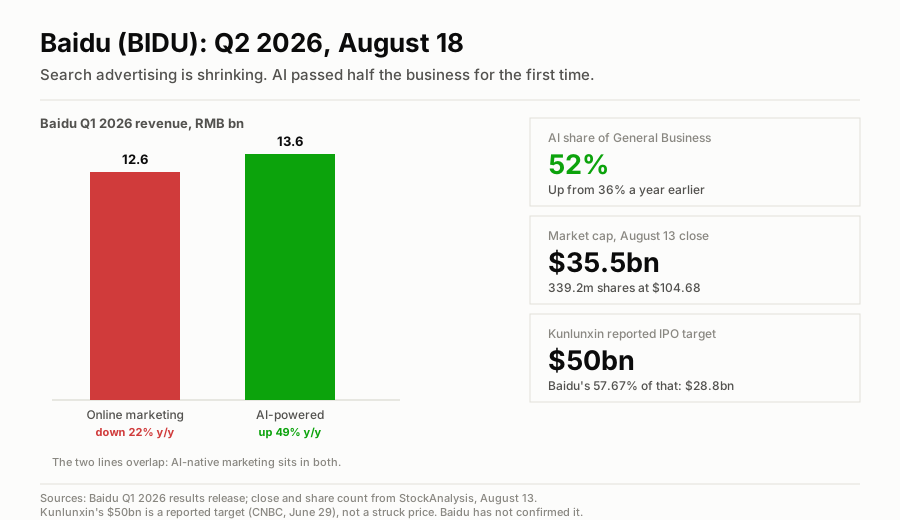
One line is falling 22% a year and the other is growing 49%. They are almost the same size.
When Does Baidu Report Q2 2026 Earnings?
Tuesday, August 18, before the US market opens, with the earnings call at 8:00am ET, which is 8:00pm Beijing time. Baidu filed the schedule with the SEC on a Form 6-K, so this one is confirmed rather than estimated. The quarter ended June 30, 2026.
That makes Baidu the first meaningful print of a heavy retail-and-China week. Home Depot lands the same morning, Walmart on Thursday, and the rest of the slate is in the earnings calendar.
The Ad Business Is Down A Fifth And Still Falling
Baidu's online marketing revenue was RMB 12.6 billion in Q1 2026, or $1.83 billion at the RMB 6.8980 rate the company used. That is down 22% from a year earlier.
Put the year-ago quarter next to it and the arithmetic gets uncomfortable. Online marketing in Q2 2025 was RMB 16.2 billion, itself already down 15%. If Baidu simply repeats Q1's RMB 12.6 billion on Tuesday, with no further sequential erosion at all, the year-over-year line still reads about 22% down. The comparison does not get easier until the fourth quarter.
This is the part of Baidu that used to be Baidu. China's search advertising market is being competed away by short video and by AI assistants that answer the query without sending a click anywhere, and Baidu is on both the losing and the winning side of that.
One caution on the segment labels. Baidu reported "Baidu Core" through 2025 and reports "Baidu General Business" now. The two are close in size (RMB 26.3 billion in Q2 2025, RMB 26.0 billion in Q1 2026) but they are not stated to be identical definitions, so I would take the company's own year-over-year percentages on Tuesday over any figure you or I calculate across the rename.
Half The Company Is Now Something Else
AI-powered revenue reached RMB 13.6 billion in Q1, up 49% year over year, and 52% of Baidu General Business. A year earlier it was 36%. Inside that:
- AI Cloud Infra: RMB 8.8 billion, up 79%. GPU cloud revenue specifically grew 184%.
- AI applications: RMB 2.5 billion, flat.
- AI-native marketing services: RMB 2.3 billion, up 36%.
Those three sum to 13.6 exactly, which is a small sign the disclosure is being given straight.
One trap worth flagging. Adding AI-powered revenue to online marketing does not give you the RMB 26.0 billion segment total, because AI-native marketing services sit inside both buckets by an amount Baidu has not sized. The sum lands close enough to the total that a wrong decomposition would look right.
Apollo Go, the robotaxi arm, ran 3.2 million fully driverless rides in Q1, up more than 120%, across 27 cities. Too small to move a revenue line, and the reason a chunk of the shareholder base is here at all.
What Kunlunxin Is Worth Depends Entirely On Who You Ask
Here is the fact that made me want to write this piece. Baidu's whole market capitalisation on August 13 was $35.5 billion: 339.2 million shares at $104.68. CNBC and Investing.com reported on June 29 that Kunlunxin, Baidu's AI chip unit, was seeking a Hong Kong IPO valuation near $50 billion. Baidu is the controlling shareholder with a reported 57.67%.
Run it. 57.67% of $50 billion is $28.8 billion. That is 81% of the market value of the entire parent company, and it would leave search, AI cloud, iQIYI, Apollo Go and roughly $32 billion of enterprise value being handed to you for the remaining fifth.
When a sum-of-the-parts is that good, my first assumption is that one of the parts is wrong. In this case I think it plainly is, for three reasons.
The number moved fourfold in seven weeks. TrendForce reported in May that Chinese GPU names listing in Hong Kong were being pencilled in between HK$30 billion and HK$100 billion, with Kunlunxin near the top of that band. HK$100 billion is about $12.8 billion. The South China Morning Post had a figure near $14.6 billion around the same time. Then late June brought $50 billion. A valuation that quadruples in under two months without a corresponding change in the business is a negotiating position moving, not a value being discovered.
The valuation came bundled with a purchase obligation. The June reporting included a detail worth more than the headline: potential investors were asked to commit to buying Kunlunxin chips at three to seven times the value of the IPO shares they wanted. A price struck alongside a multi-year purchase commitment is not the same thing as a price. Strip the commitment out and you are looking at a different number, and nobody outside the deal knows which one.
Nothing is struck. The Hong Kong filing was made confidentially in January and the STAR Market listing guidance process started on May 7. There is no prospectus, no price range and no float. Baidu has not confirmed the $50 billion figure at all.
So run the low end too, because that is the point of running it at all. At the HK$100 billion framing, Baidu's stake is worth about $7.4 billion, or 21% of market cap. Still real, and a completely different investment case from 81%.
My read: the stake is a genuine and underpriced asset, and the range of defensible values for it is so wide that it cannot carry a thesis on its own. What it can do is give Tuesday a second scoreboard. If management puts any figure, timeline or float detail on Kunlunxin during the call, that is new information in a way the revenue line will not be.
Three Things That Decide Tuesday
The AI share number. 52% last quarter. At 55% or better the mix shift is accelerating faster than the ad decline. Below 52% the story stalls.
The sequential ad line. The year-over-year figure will look bad whatever happens. What matters is Q2 online marketing against Q1's RMB 12.6 billion. Flat is fine. Another leg down is not.
Any Kunlunxin detail at all. A float size, a timeline or a management figure would be genuinely new.
For where Baidu sits in the wider China AI trade, the Alibaba Qwen rally and what CXMT is doing to DRAM are the two pieces here with the most context. The buy-or-wait verdict, and the balance-sheet arithmetic that puts the operating business at about $7.3 billion, are in is Baidu a buy before August 18.
The Options Angle
BIDU options price a ±5.8% move for August 18, per Investing.com's read of the chain. Against the August 13 close of $104.68 that brackets roughly $98.61 to $110.75.
Baidu's recent record against its own implied move is the interesting part, and it cuts one way. The stock has exceeded the implied move in three of its last eight reports, and the two clear breaks were both to the downside: February 2026, implied 4.9%, actual −9.2%; November 2025, implied 4.8%, actual −11.5%. The most recent report went the other way, with a 6.9% implied against a −2.4% actual.
That pattern argues against selling premium here and it does not argue for buying a straddle either, because the base rate is still five in eight inside the range. I could not source live contract prices at the time of writing, so the row below is quoted against the implied move rather than a strike price, and it is a pass.
Trade log
| # | Stance | Structure | Strikes and expiry | Cost or credit | Spot at writing | Implied move | Breakeven |
|---|---|---|---|---|---|---|---|
| 1 | Pass, scored a loss | Long straddle | At-the-money, Aug 21 expiry | No live chain sourced; costs roughly the implied move, ~5.8% of spot | $104.68, Aug 13 close | ±5.8% | Needs a move beyond ±5.8% |
Scored: BIDU closed down about 13% on August 18, well beyond the ±5.8% implied move, so per the scoring note set in advance, this pass is marked a loss: buying the straddle would have paid off.
The One-Line Read
Baidu's ad business is melting and its AI business already replaced it, and the print did not fix either: the ad decline eased a point, the bottom line missed hard, and the stock broke its implied move to the downside for the third time in nine reports.
Next up:PCE inflation, Wednesday at 8:30am ET →
More on $BIDU
Updated Every Saturday
The Week Ahead
Every earnings date, Fed event and setup for the current trading week, on one page.
Refreshed Weekly
Earnings Calendar
Who reports next, when, and what consensus and the whisper expect.
The Week-Ahead Brief
Don’t miss next week’s setups. Get the Sunday brief.
Latest issue, Sep 27“Micron, PCE and the jobs report that decides October”
Every Sunday: next week’s earnings dates, Fed days and the trades worth watching, from the same desk that writes the week-ahead hub. Free, built for retail investors.