Is Baidu (BIDU) a Buy Before Aug 18? $28B of It Is Cash
Baidu reports Q2 on August 18 with a $35.2bn market cap and $27.9bn of net cash and investments behind it. The verdict on the shares, and why the print itself is the wrong thing to buy.
TL;DR
- Yes on the shares, no on the print. BIDU closed $103.67 on August 14, 37% below its 52-week high, for a market cap of $35.2 billion across 339.2 million ADS.
- Most of what you buy is the balance sheet. Baidu reported RMB 279.3 billion ($40.49 billion) of total cash and investments at March 31 against RMB 86.8 billion ($12.6 billion) of borrowings. Net, that is $27.9 billion, or 79% of the market cap.
- So the operating company costs about $7.3 billion. Search, AI cloud, iQIYI, Apollo Go and a controlling stake in an AI chip business, for roughly a fifth of the price.
- The number that spoils it: Q1 free cash flow was negative RMB 3.25 billion (−$470 million). A cash pile being spent on GPUs is not the same asset as a cash pile sitting still, and this is the first thing I would check on Tuesday.
- Consensus has been cut hard into the print. The Street carries $1.51 of EPS and $4.65 billion of revenue, and the consensus EPS figure has come down about 21% in a month. Options price ±5.8%.
- UPDATE (August 18): the print missed and the pass on holding through it was right. Revenue of $4.62 billion landed roughly in line with consensus, but adjusted EPS of about $1.05 missed hard, free cash flow worsened to negative $1.18 billion from Q1's −$470 million, and the stock closed down about 13% at $90.87. That is the free cash flow deterioration this piece said to watch for, and it happened. Row 2 (the pass on holding through the print) scores as a win: $103.67 to $90.87 is a loss of about 12.4% that the pass avoided. Row 3 (the pass on the straddle) scores as a loss: the ±5.8% implied move was broken to the downside by more than double. Row 1, the 12-month long, enters today as planned, at the $90.87 close rather than the $103.67 reference level this piece was written against, a materially better entry price for the same balance-sheet thesis, against a free-cash-flow trend that has now deteriorated for two straight quarters.
More on $BIDU: Baidu (BIDU) Earnings Aug 18: AI Passed Search, and the Chip Unit May Be Worth More Than Baidu →
Is Baidu a Buy Before the August 18 Print?
The shares are a buy at $103.67 on a 12-month view. Buying them specifically before Tuesday morning is a different bet and a worse one, and I am passing on that half.
Baidu reports Q2 before the US open on Tuesday, August 18, with the call at 8:00am ET. The revenue lines, the segment detail and the Kunlunxin arithmetic are in the earnings preview. This is the buy-or-wait call on top of it.
The Board
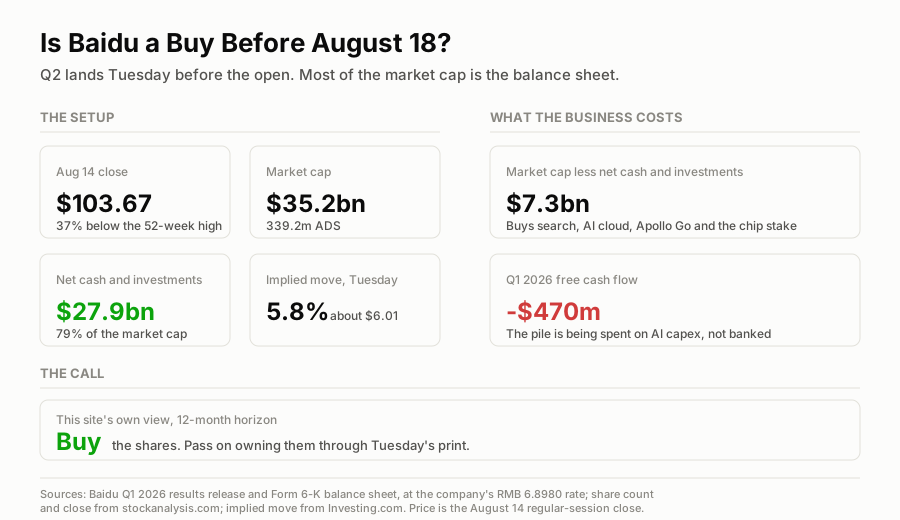
Four fifths of the price is the balance sheet. The argument is about the other fifth.
What $35 Billion Actually Buys
Baidu's own first-quarter results release puts total cash and investments at RMB 279.3 billion, which the company converts at RMB 6.8980 to $40.49 billion. That is more than the entire company is worth on the Nasdaq. It is also a gross figure, and gross figures flatter.
The debt against it: the balance sheet in the same filing carries short-term loans of RMB 3.98 billion, current and non-current long-term loans of RMB 22.59 billion, notes payable of RMB 53.56 billion and convertible senior notes of RMB 6.67 billion. Add them: RMB 86.8 billion, or $12.6 billion.
Net of every one of those, Baidu holds about RMB 192.5 billion, which is $27.9 billion. Against a $35.2 billion market cap that leaves roughly $7.3 billion for the actual businesses: China's largest search engine, an AI cloud growing 79%, the consolidated iQIYI stake, Apollo Go's robotaxi fleet, and 57.67% of Kunlunxin.
Three caveats, because a number this flattering has usually had something removed from it.
iQIYI is consolidated, so some of that cash is not Baidu's. Baidu controls iQIYI and therefore books its whole balance sheet, but minority shareholders own a real slice of both the cash and the debt. I cannot size the deduction from the quarterly release, and it is not trivial.
The cash is mostly onshore. RMB held in mainland China under capital controls is worth less to a US holder than the same figure in dollars in Delaware, and every Chinese ADR has traded at a discount for that reason for years. This is not a mispricing nobody has noticed.
"Total cash and investments" is Baidu's own aggregate, and it includes long-term time deposits and held-to-maturity instruments alongside actual cash. It is a fair figure and it is the company's own, but it is not $40 billion of money available on demand.
Even after all three, the discount is large enough that it survives being argued with. That is why I want the shares.
The Number That Undercuts My Own Argument
Free cash flow in Q1 2026 was negative RMB 3.25 billion, or −$470 million.
A balance-sheet case assumes the balance sheet stays where it is. Baidu is spending against it, on the GPU capacity that produced the 184% growth in GPU cloud revenue the preview covers. That spending may well be the best use of the money. It is still money leaving.
One quarter of negative free cash flow against $27.9 billion is noise. Eight of them is a thesis breaking, and there is no rule that says a company with a large cash pile must stop at one. I will learn more from Tuesday's cash flow statement than from the revenue line, and I would read the operating cash flow and capex lines before the EPS headline.
Why the Discount Has Not Closed
The advertising business is falling 22% a year and the comparison does not ease until Q4. The Street has cut its Q2 EPS estimate by roughly 21% over the past month to $1.51, which is a group of analysts learning something unpleasant rather than a bar being helpfully lowered. Revenue consensus of $4.65 billion implies growth of under 2%.
I should flag one thing about that EPS figure: compiled consensus for Chinese ADRs mixes GAAP and non-GAAP reporting, and Baidu printed RMB 8.76 GAAP and RMB 12.06 non-GAAP per ADS in Q1, which are $1.27 and $1.75. The $1.51 consensus sits between them and I could not confirm which basis it is struck on, so I would not trade the beat-or-miss on it.
And the catalyst that would close the gap has no date. Kunlunxin's reported $50 billion Hong Kong IPO target came with a request that investors commit to buying chips at three to seven times their allocation, there is no prospectus, and the preview walks through why I think the real number is a good deal lower. A sum-of-the-parts that leans on a listing nobody has priced is worth waiting on. It is not worth being certain about.
Twenty analysts carry an average target of $128.93 with a range from $81 to $177. I read a 2.2x spread from low to high, on a company this large and this well covered, as a sell side that has given up trying to value the parts. For the wider China AI setup, the Alibaba Qwen rally and what CXMT is doing to DRAM are the two pieces here with the most context.
The Options Angle
BIDU options price a ±5.8% move for Tuesday, which against Friday's $103.67 close brackets roughly $97.66 to $109.68.
The preview passed on buying that volatility, and I am keeping the pass rather than restating it. The reasoning was the base rate: BIDU has broken its implied move in three of its last eight reports, so five in eight settled inside, and paying 5.8% for a 3-in-8 shot is the wrong side of that. What I would add now is the skew. Both clear breaks were downward, at −9.2% in February and −11.5% in November 2025, which makes this an event with a fat left tail and a thin right one.
That skew is the reason the share call and the event call point different ways. I want to own Baidu. I do not want to own it across a print whose two recent surprises were both 9% or worse to the downside, when nothing in the quarter can revalue the cash pile that is my actual reason for being here. Waiting for Tuesday's close costs me nothing if the thesis is a 12-month one.
No live chain could be sourced with the market shut, so the structure below is quoted against the compiled implied move.
Trade log
| # | Stance | Structure | Strikes and expiry | Cost or credit | Spot at writing | Implied move | Conviction | Breakeven |
|---|---|---|---|---|---|---|---|---|
| 1 | Bullish, entered | Long shares | Common stock, entered Aug 18 close | n/a | $90.87 (Aug 18 close) | ±5.8% (realised ~-13%) | 6/10 | open; scored on a 12-month view |
| 2 | Pass, won | Long shares | Common stock, held through the print | n/a | $103.67 (Aug 14 close) | ±5.8% (realised ~-13%) | 6/10 | closed -12.4% at $90.87; the pass avoided the loss |
| 3 | Pass, lost | Long straddle | At-the-money, Aug 21 expiry | ~5.8% of spot, no live chain | $103.67 (Aug 14 close) | ±5.8% (realised ~-13%) | 5/10 | move exceeded ±5.8%; a straddle would have profited |
Row 2 is scored as the trade not made, and it won: BIDU fell about 12.4% from the $103.67 reference to the $90.87 close, so passing on holding through the print saved that loss. Row 3 is the other side of the same coin and lost: the realised move more than doubled the 5.8% implied, which is exactly what a long straddle needed. Row 1 enters today, at the better price the miss created. All three rows are in the Track Record ledger.
The Price I Would Pay
$103.67 is already a price I would pay, which is why row 1 exists at all. The level where I would stop caring about the print and simply buy is around $95, some 8% lower, where net cash and investments would cover about 87% of the market cap.
That is this site's own number on a 12-month view, and its basis is the balance sheet rather than the earnings line: I am underwriting a $7.3 billion price for the operating businesses, not a multiple on an EPS figure I cannot even pin to a reporting basis. What makes me wrong is the free cash flow. If Tuesday shows a second consecutive quarter of cash going out the door at a similar rate, the floor I am relying on is moving, and I will say so in this piece rather than a new one.
The rest of a heavy Tuesday, and the retail earnings stacked behind it, are in the week ahead.
The One-Line Read
Four fifths of Baidu's market cap was cash and investments, and the print made the fifth you pay for cheaper: the stock fell about 13% on a hard EPS miss and a worsening cash burn, the pass on holding through it won, and the long enters today at $90.87 instead of $103.67.
Next up:PCE inflation, Wednesday at 8:30am ET →
More on $BIDU
Updated Every Saturday
The Week Ahead
Every earnings date, Fed event and setup for the current trading week, on one page.
Refreshed Weekly
Earnings Calendar
Who reports next, when, and what consensus and the whisper expect.
The Week-Ahead Brief
Don’t miss next week’s setups. Get the Sunday brief.
Latest issue, Sep 27“Micron, PCE and the jobs report that decides October”
Every Sunday: next week’s earnings dates, Fed days and the trades worth watching, from the same desk that writes the week-ahead hub. Free, built for retail investors.