Is Rumble a Buy? The AI Math, a 20% Short Float, and Weekly Options at Squeeze Prices
RUM traded near $8.37 on August 17, up about 35% in four sessions since Q2. The AI valuation on the full 503M share count, the 20% short float, and whether August 21 weeklies are worth paying for.
TL;DR
- Three questions, three answers. Undervalued AI play: not once you count all the shares. Short squeeze play: the structure is real, but most of the easy move has already happened. Weekly options here: bad risk/reward this week, and the trade log below says why.
- RUM traded at $8.37 around 1:03pm ET on August 17, up 12.2% on the day, an intraday snapshot rather than a close. That is +34.8% from the $6.21 close on August 10, the day it reported Q2, with no new company filing behind the extra leg.
- The squeeze arithmetic: 26.9 million shares short, 20.1% of a 133.9 million-share float, about 11.7 days to cover at recent volume, against a register where Tether holds 48.7% beneficial ownership and the listed count is 400 million shares.
- The valuation most screens quote is $3.35 billion. Add the 102.9 million pre-funded warrants Tether disclosed in its June Schedule 13D/A and the effective share count is 502.9 million, so the market is paying closer to $4.2 billion, roughly 11.7x the annualized midpoint of the company's own $87-93 million Q3 guide.
- Recent implied volatility readings sit in the high 70s to low 80s, which prices the August 21 weeklies at roughly a ±10% range for four sessions with no dated catalyst inside the window.
More on $RUM: Rumble Earnings Preview (August 10): The Consensus Number Is For A Company That No Longer Exists →
The Board
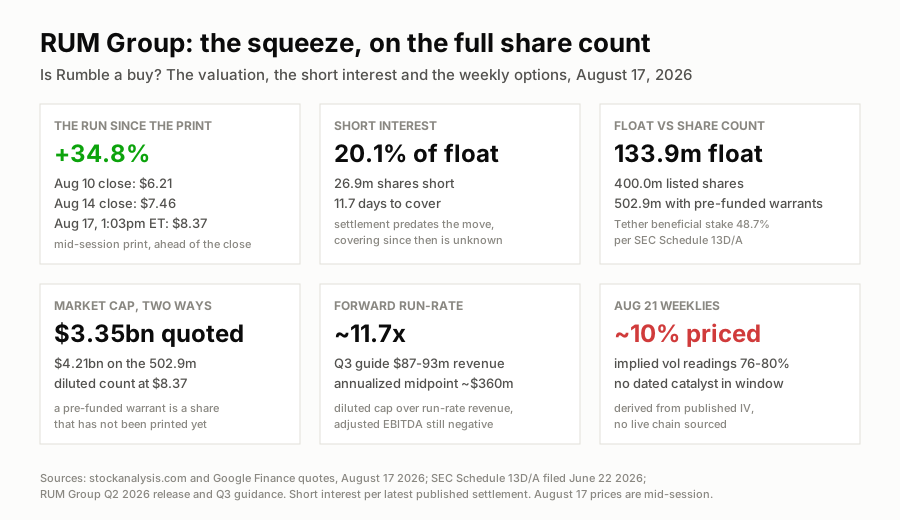
The market cap on the screen and the market cap in the SEC filing are two different numbers.
Is Rumble an Undervalued AI Play?
Cheaper per dollar of guided revenue than the big AI-cloud names, yes. Undervalued, I'm not convinced, because the popular version of the valuation is computed on the wrong share count.
The screens quote a $3.35 billion market cap: 400 million listed shares at the August 17 intraday price. But Tether's Schedule 13D/A from June 22 spells out the real denominator: 276.2 million Class A shares, 123.7 million exchangeable shares, and 102.9 million pre-funded warrants, which is 502.9 million in total. A pre-funded warrant is a share that has not been printed yet. Count them and the effective capitalization at $8.37 is about $4.2 billion.
Set that against the company's own numbers. The Q2 release guided Q3 revenue to $87-93 million, the first formal guide in the company's history, and the midpoint annualizes to roughly $360 million. That is about 11.7x forward run-rate revenue on the full share count, for a business that reported an adjusted EBITDA loss of $16.6 million, held $203.3 million of cash at June 30, and has more than 200MW of unmonetized power still to finance. StockStory pegged Q2 free cash flow at about minus $92 million, most of it deal costs and the capital build.
The asset is real. Roughly 22,000 H100 and H200 GPUs, ten data centres, and a $270 million multi-year Together AI contract are not a story stock's props, and the full background is in the Q2 earnings preview and results hub. What the entry price buys matters more than whether the asset exists. Sell-side coverage is two or three analysts depending on who is counting, with published targets ranging from about $14 to $22, and I would not lean on either number: a target set by that few people on a company this recently reshaped is a sketch.
Is RUM a Good Short Squeeze Play?
As a structure, yes. As a trade entered at $8.37 on August 17, most of it has already happened.
The mechanics are genuinely tight. Per stockanalysis.com, short interest at the latest published settlement was 26.9 million shares, 20.1% of the float and about 11.7 days to cover at recent average volume near 2.3 million shares a day. Fintel's float-based reading is close at 21.4%. The float itself is the interesting part: 133.9 million shares tradeable out of 400 million listed, because Tether's 48.7% beneficial stake and insider holdings sit locked around it. A float squeeze in a name like this behaves the way T3 Defense did in July: small tradeable supply, forced buyers, and a price that moves further than the fundamentals ask.
Which is roughly what the last four sessions look like. The stock closed the report day at $6.21, closed Friday August 14 at $7.46, and printed $8.37 mid-session Monday, up 34.8% from the report-day close with nothing new in the SEC file. Shorts covering an 11-day position into a 134 million-share float is the simplest available explanation for the second leg.
Two things temper the trade from here. Short interest data is stale by construction: the settlement behind that 26.9 million figure predates the whole move, so nobody outside the lending desks knows how much covering is already done. And supply exists above this price. Tether's credit facility to the Northern Data holding company carries a conversion right, exercisable from its first anniversary, at the greater of a 10-day VWAP or $7.88 per share. The stock crossed that reference level this morning. A cash-burning company whose largest holder has a convert struck at $7.88 is not a chart with clean air overhead.
What the Move Already Paid
The earnings preview on this site logged a long straddle into the August 10 print against a ±12.1% implied move and a $6.39 spot. Close-to-close, August 7 to the August 14 expiry, the stock moved +16.7%. Realized beat implied again, the straddle paid, and the two pass rows land with it in the next scorecard against their own terms.
That result is the opposite of a reason to buy this week's options. The straddle had a dated event inside its window: the first guide in company history. This week's contracts have a tape that already moved and nothing on the calendar.
Are Weekly Options Good Risk/Reward Right Now?
No. The pricing did not stay behind while the stock ran.
A live chain could not be sourced this session (the usual public sources were unavailable), so this is quoted from the volatility level rather than a premium: Fintel's 30-day implied volatility reading is 76.1, and late-July options flow was marked at 80.3% implied. Volatility in the high 70s prices an at-the-money weekly straddle at roughly 10% of spot for the four sessions to August 21, which puts the breakeven on a weekly call bought today somewhere near $9 by Friday.
So the weekly bull needs the squeeze to deliver a further ~10% on top of 35%, inside four days, with no scheduled catalyst, or the premium evaporates. The next hard dates are the late-August short interest settlement publication and a Q3 report months out. Both sit outside the window. Buying weeklies here is renting squeeze-priced volatility for the exact period in which nothing is scheduled to happen.
The Options Angle
- The chase is the pass. After four sessions and 35%, the entry embeds the squeeze; I'd rather miss the next leg than fund someone's exit.
- The level I'd pay for the AI thesis is a close back under $7.00, where the diluted capitalization drops to roughly $3.5 billion, under 10x the run-rate guide, with the November print as the catalyst that either confirms the $87-93 million or breaks it.
- Weekly calls fail the arithmetic above. A defined-risk structure into the Q3 report would interest me once that chain exists and can be priced; nothing this week does.
Trade log
| # | Stance | Structure | Strikes and expiry | Cost or credit | Spot at writing | Implied move | Conviction | Breakeven |
|---|---|---|---|---|---|---|---|---|
| 1 | Pass | Long shares at market | n/a | n/a | $8.37 intraday, Aug 17 ~1:03pm ET | ~±10% weekly, derived | 6/10 | Scored against the close four weeks out |
| 2 | Bullish, pending | Long shares on a retracement | Trigger: a close under $7.00 | n/a, no entry yet | $8.37 intraday, Aug 17 ~1:03pm ET | ~±10% weekly, derived | 6/10 | Scored from the trigger close if it fills |
| 3 | Pass | Long weekly calls | ~$8.50C area, Aug 21 | Not sourced; ~10% straddle-equivalent | $8.37 intraday, Aug 17 ~1:03pm ET | ~±10% weekly, derived | 7/10 | Needs roughly $9+ by Friday |
Rows are struck against an intraday snapshot because the piece was written mid-session; no live August 21 chain could be sourced, so the weekly pricing is derived from the two published implied volatility readings named above rather than from a quoted premium.
The One-Line Read
The GPU business is real and so is the squeeze; at $8.37 both are already in the price. I'd own it again near $7, and I would not rent it for four days at 80 vol.
Next up:ISM Manufacturing PMI, today at 10:00am ET →
More on $RUM
$RUM · 2026-08-09
Rumble Earnings Preview (August 10): The Consensus Number Is For A Company That No Longer Exists
$MU · 2026-09-30
Micron Earnings Expectations Tracker: Guidance, Estimates, Results and Stock Moves Every Quarter
2026-09-25
Akamai's $11.6 Billion Anthropic Deal Pushes the AI Ledger Past $900B
Updated Every Saturday
The Week Ahead
Every earnings date, Fed event and setup for the current trading week, on one page.
Refreshed Weekly
Earnings Calendar
Who reports next, when, and what consensus and the whisper expect.
The Week-Ahead Brief
Don’t miss next week’s setups. Get the Sunday brief.
Latest issue, Sep 27“Micron, PCE and the jobs report that decides October”
Every Sunday: next week’s earnings dates, Fed days and the trades worth watching, from the same desk that writes the week-ahead hub. Free, built for retail investors.