Why Is Everything Crashing? MU, SNDK and SPCX Got Wrecked on July 28 and the Index Barely Moved
Why is everything crashing? July 28 2026: the Kospi fell 10.8%, MU dropped 6.7% and SNDK 7.3% premarket, yet the S&P 500 lost only 0.38%. The catalyst, and the options plays that fit it.
TL;DR
- Nothing crashed at the index level. The Dow closed up 0.62% at 52,534.84, the S&P 500 fell 0.38% to 7,384.66 and the Nasdaq Composite fell 1.31% to 24,605.01. If your screen looked like a crash, it is because of what you own, not what the market did.
- The damage was overnight and sector-specific. South Korea's Kospi closed down 10.8% at 6,023.66, its weakest since April, halting trading more than once. SK Hynix fell 14.7%. Samsung fell 13.4%.
- US memory gapped straight into it. At 7:15am ET: MU down 6.7%, SNDK down 7.3%, STX down 7.2%, WDC down 7.6%. ASML fell more than 8% and BE Semiconductor 9%.
- The trigger was not earnings. It was a report that a Chinese state-backed firm has started mass-producing immersion DUV lithography machines, roughly 5 in 2026 and 20 in 2027, landing on top of CXMT's 466% Shanghai debut.
- SPCX fell 1.36% to $113.50, which is a different problem entirely: it has earnings August 4 and a 911.5 million share lock-up on August 6. Dated risk, not narrative risk. That distinction decides which expiry you buy.
Why Is Everything Crashing Today?
The short answer: it isn't. One sector is being repriced for Chinese competition, that sector happens to be the most crowded trade of 2026, and everything you own is probably in it.
Here is the split, in one line. The Dow rose 324.76 points on good earnings from UPS, Coca-Cola and PayPal, all of which beat and lifted guidance. The Nasdaq lost 327.07 points because semiconductors got hit for a second straight session. Same tape. Opposite outcomes.
That is what a rotation looks like from the inside. It feels like a crash if your account is memory, chip equipment and space. It feels like nothing if you own logistics and soda.
The Board
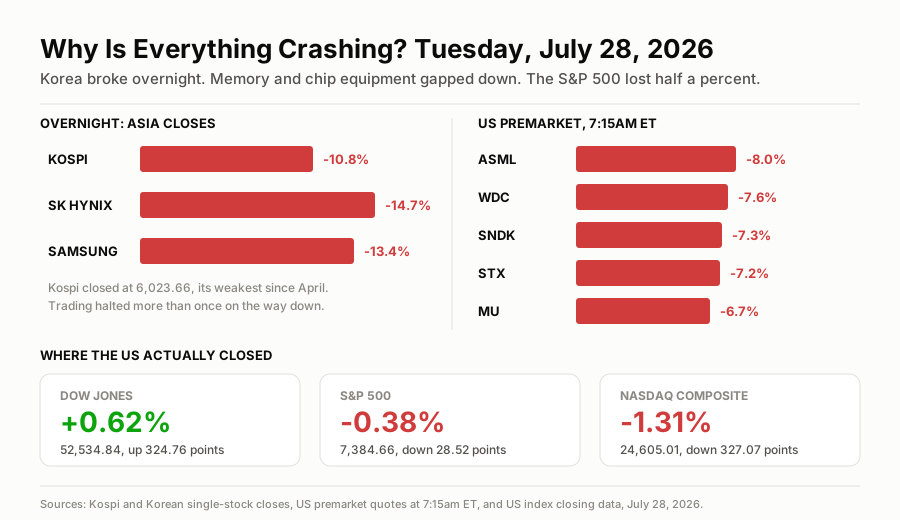
The bars are the crash. The tiles are the market. They are not the same picture.
What Actually Broke: China Built the Machine
The overnight catalyst was a report that an unnamed Chinese state-backed company has begun manufacturing domestically developed immersion deep ultraviolet (DUV) lithography systems. First production run is roughly 5 machines in 2026, rising to about 20 in 2027, with initial deliveries expected later this year to SMIC, Hua Hong and CXMT.
DUV immersion is the tool ASML has effectively owned for two decades. It is how you print anything below about 40nm without EUV. If China can build its own, the export-control moat stops being a moat and starts being a delay.
Now the caveat, because the tape did not price one. These machines are aimed at 28nm-class production, using multi-patterning as the workaround for finer geometries. That is several generations behind what ASML ships today, and five units a year is not a supply chain. China accounted for 14% of ASML's 6.6 billion euros of net system sales last quarter. An 8% drawdown on that news is the market pricing a 2029 problem in a single session.
The second leg is memory, and it stacks on yesterday. CXMT debuted in Shanghai up 466%, raising about $8.6 billion to build DRAM capacity, in a sector whose entire bull case is that supply cannot keep up. We wrote the full explainer on what CXMT actually is and whether you can buy it, and the first time it broke Micron in MU below $900.
Put the two together and you get the fear that moved Korea: China is closing the gap on the tools and the chips at the same time.
MU, SNDK, STX, WDC: The Damage in Order
Month-to-date, this is not a dip. It is a regime change in the fastest-moving group on the board.
- SNDK is down about 35.7% for the month and 24.7% in a single week, trading around $1,183 intraday after a $1,212 high and $1,164 low. It is still up more than 500% year to date and sits at roughly 8.1 times forward earnings. Both of those facts are true at once, and that is the whole argument.
- MU is down 23.3% month-to-date, on pace for its worst month since June 2022, and sits about 28% below its 52-week high set on June 25, 2026. It is still up 208% in 2026.
- STX and WDC gapped 7.2% and 7.6% lower premarket, which matters because they are NAND and HDD, not DRAM. When the whole storage complex moves together on a DRAM headline, that is sector beta, not analysis.
- SK Hynix ADRs closed at $143, below the $149 IPO price.
The bear case is simple: a fourth DRAM player just got $8.6 billion of state money and China may be building its own tools. The bull case is equally simple and mostly unchanged: CXMT competes in commodity DRAM and cannot touch high-bandwidth memory, and HBM is where the AI margin lives. Nothing in today's news moved an HBM roadmap. What it moved was the multiple people are willing to pay for a cyclical that ran 200% to 500% in seven months. We laid out the levels version of this in whether the memory dump continues or bounces.
SPCX Is a Different Crash
SPCX closed down 1.36% at $113.50, off $1.57. That is a rounding error next to memory, but the setup underneath it is far more dangerous, because it has dates.
The stock is roughly 50% below its $225.64 high from June 16. First-ever earnings land after the close on Tuesday, August 4. Two trading days later, on August 6, up to 911.5 million shares worth roughly $116 billion become eligible to trade as the first staged lock-up tranche unlocks.
That is a known quantity of supply arriving on a known day into a stock that has already halved. Our full teardown of the valuation is in SpaceX broke its IPO price.
Memory is crashing on a story with no scheduled resolution. SPCX has two hard dates. Those need completely different trades, which is the next section.
Tomorrow Is the Actual Risk: Fed at 2pm, Then Microsoft and Meta
None of today's damage is the week's main event. The FOMC statement lands at 2:00pm ET Wednesday, July 29, with the press conference at 2:30pm. Economists broadly expect a hold at 3.50% to 3.75%, but fed funds futures put the odds at only about 64% hold against a 36% chance of a hike to 3.75-4.00%. A one-in-three hike is not priced as a non-event.
Then Microsoft and Meta report after that same close, with Apple Thursday and Amazon Friday. We built the hour-by-hour version in the Fed decision and Microsoft and Meta timetable, and the full setup in Monday's close.
Two binary events, five hours apart, on the same afternoon.
The Options Angle: Dailies, Weeklies, and What Not to Buy
This is a dispersion tape. The S&P moved 0.38% while individual names moved 7% to 13%. That single fact rules half the option chain out.
- "Daily plays" only exist on the index. SPY, QQQ, IWM and the cash indices list an expiration every trading day. MU, SNDK, STX and SPCX do not. Their shortest contract is the Friday weekly, so a "0DTE MU trade" is really a three-day position wearing a day trade's costume. If you want genuine same-day exposure to Wednesday's Fed, the only clean instrument is index options, and the index is precisely the thing that has stopped moving.
- Anything expiring Friday July 31 is paying for two events. Buy a weekly today and you are funding the Fed at 2pm Wednesday plus Microsoft and Meta at 4pm Wednesday. After 2:30pm Wednesday the event premium bleeds out of index contracts whether you were right or not. Directionally correct and still down is the standard outcome here.
- SNDK is a spread-only name for almost everyone. At roughly $1,183 a share, one contract controls about $118,300 of stock. A covered call requires you to own that. A cash-secured put at a $1,000 strike ties up $100,000. Fractional contracts do not exist. In a normal account, the only SNDK structures that fit are debit spreads, and that is a sizing fact, not a preference.
- Buy spreads, not naked premium, after a 7% gap. Implied volatility is bid across the memory complex right now. A long put is a bet on direction and a bet that IV keeps rising. Selling a further strike against it hands some of that vega back and cuts the entry cost, at the price of a capped payoff. In a group that gaps 7% before the bell, capped is fine.
- Do not hedge memory with SPY puts. The index closed down 0.38% on a day SNDK traded down double digits. Your hedge would have paid you almost nothing against the thing that actually hurt. SMH or SOXX is the real beta, and single-name puts are the honest version.
- The premium-selling side, fairly stated. IV is genuinely rich, and selling it is the highest-expectancy trade in most markets. Not this one, not yet. An iron condor needs a range, and a stock down 24.7% in a week does not have one. Rich IV after a spike is mean reversion. Rich IV in the fourth week of a downtrend is the market repricing the distribution, and you are being paid to be short that.
- SPCX is the one place a long-premium trade has a calendar. July 31 weeklies expire before both the August 4 print and the August 6 unlock, which makes them worthless as an event trade. If you want the event, you need August expiries that cover both dates. A straddle spanning earnings and a lock-up is expensive because the market can also read a calendar, so the honest version is a directional put spread into August 6 rather than paying up for both tails.
The One-Line Read
Everything is not crashing. One extremely crowded trade is being repriced for the possibility that China builds its own lithography tools and its own DRAM, the Dow made a new leg higher on parcels and soda while it happened, and the only genuinely dangerous thing on the calendar is a Fed decision and two megacap prints landing within five hours of each other tomorrow afternoon. Trade the dispersion, not the index, and stop buying weeklies that expire before the catalyst.
More on Markets Today
$SPY · 2026-07-27
Stock Market Today, July 27, 2026: Dow Climbs 262 Points on Cheap Oil While Nvidia's 5% Drop Sinks the Nasdaq
$SKHY · 2026-07-27
KOSPI and SK Hynix After the Crash: Buy the Dip, Buy Puts, Sell Cash-Secured Puts, or Wait?
$SPY · 2026-07-27
SPY Is Only 3% Off Its Record. So Why Does It Feel Like a Bear Market?
The Sunday Setup
Enjoyed this breakdown? Don’t miss the next market setup.
Get deep-dive analyses delivered to your inbox every Sunday. Free, and built for retail investors.
Comments
0 totalNo comments yet. Be the first to drop a take.