Ultragenyx (RARE): DTX401's FDA Decision Lands August 23, Built at the Plant That Failed UX111
Ultragenyx's DTX401 gene therapy for GSDIa gets an FDA verdict August 23, made at the Bedford, MA plant whose findings sank a different Ultragenyx gene therapy last year. RARE trades near $26.
TL;DR
- The FDA's target action date for DTX401, Ultragenyx's gene therapy for glycogen storage disease type Ia (GSDIa), is August 23, 2026. It would be the first approved treatment for the disease itself rather than its symptoms.
- The pivotal data cleared its bar cleanly. In the Phase 3 GlucoGene study, DTX401 patients cut daily cornstarch intake 41.3% at Week 48 against 10.3% on placebo, p<0.0001, in a 44-patient randomized, placebo-controlled trial.
- DTX401 is made at the same Bedford, Massachusetts facility whose inspection findings contributed to a Complete Response Letter for a different Ultragenyx gene therapy, UX111, in July 2025. The FDA has since accepted DTX401's own BLA for review, filed after that CRL.
- Ultragenyx has had two large stock-moving setbacks in the past 13 months: the UX111 CRL, and a 44.5% one-day drop on December 29, 2025, when setrusumab missed the primary endpoint in both of its Phase 3 bone-disease trials. UX111's resubmission carries its own PDUFA date, September 19, five weeks after this one.
- RARE closed at $26.49 on August 14, a $2.60 billion market cap against a 52-week range of $18.29 to $39.89 and a Street consensus target near $52.84. Q2 revenue hit a record $214 million.
More on Earnings: Stock Market Week Ahead (Sep 21-25): Costco, AutoZone, KB Home and a 5% Ten-Year →
When Is the Ultragenyx FDA Decision on DTX401?
August 23, 2026. That is the PDUFA target action date the FDA assigned when it accepted Ultragenyx's Biologics License Application for DTX401, an AAV8 gene therapy for GSDIa, under Priority Review. The company completed its rolling BLA submission in December 2025 and the FDA accepted it with Priority Review in February 2026, which is a six-month review clock rather than the standard ten months. DTX401 also carries Rare Pediatric Disease, Orphan Drug, Fast Track and RMAT designations, and no FDA advisory committee meeting has been scheduled ahead of the date.
GSDIa is an ultra-rare inherited metabolic disorder: patients cannot release stored glucose from the liver on their own and manage it today by eating cornstarch every few hours around the clock, including through the night, to avoid dangerous drops in blood sugar. Roughly 6,000 patients are diagnosed across developed markets. There is no approved treatment for the underlying disease, only for managing the symptom.
The Board
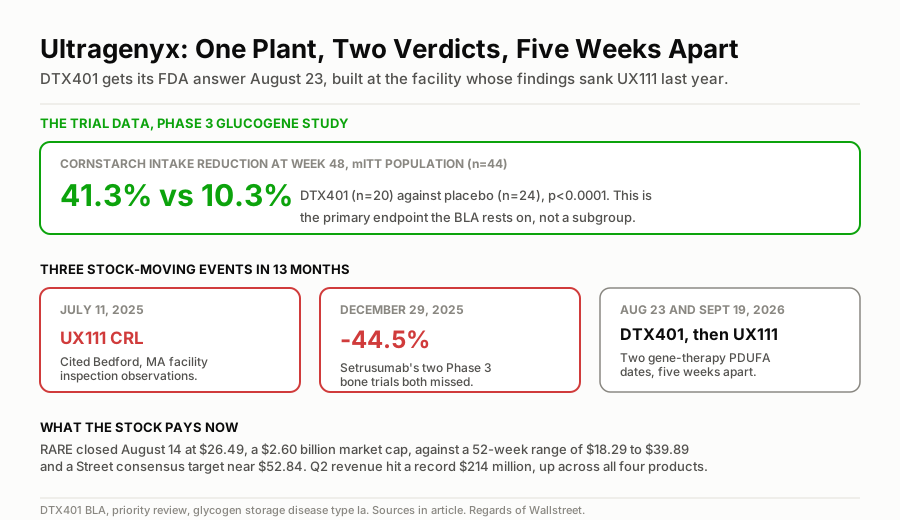
Two gene-therapy verdicts five weeks apart, after two large setbacks in the year before them.
The Trial Data Is the Clean Part of This Story
Phase 3 GlucoGene randomized 46 patients, with 44 in the modified intent-to-treat population: 20 on DTX401, 24 on placebo. At Week 48, the DTX401 arm cut daily cornstarch intake 41.3% on average, against 10.3% for placebo, a result Ultragenyx reported as statistically significant at p<0.0001 when the topline came out in May 2024. The BLA also carries longer-term open-label data on 52 treated patients with up to six years of follow-up, showing maintained glucose control and quality-of-life improvement.
I'm flagging this because it is not the usual shape of a binary biotech catalyst on this site. When we previewed Capricor's deramiocel decision, the primary endpoint barely cleared significance at p=.029 and the key secondary endpoint missed once the FDA made the company redo the statistics. DTX401's primary result is a four-decimal p-value in a randomized, placebo-controlled trial, not a post-hoc reanalysis. Whatever risk sits around August 23, it is not "does the drug work."
The Plant With a Record
DTX401 will be manufactured entirely at Ultragenyx's own gene therapy facility in Bedford, Massachusetts, which opened in 2023. That is the same building at the center of the company's last regulatory setback.
In July 2025, the FDA issued a Complete Response Letter for UX111, a different AAV gene therapy for Sanfilippo syndrome type A. The agency cited chemistry, manufacturing and controls questions plus "observations from inspections of the company's manufacturing facilities." Ultragenyx said at the time, and has maintained since, that the FDA raised no questions about UX111's clinical data and that the findings were facility- and process-related rather than tied to product quality. The company resubmitted UX111's BLA in early 2026, and the FDA accepted it with a new PDUFA date of September 19, 2026; if approved, that product will be made partly at Bedford and partly at a second site, Andelyn Biosciences in Columbus, Ohio.
Here's the part I keep coming back to. DTX401's own BLA was accepted in February 2026, seven months after the UX111 CRL. The FDA had already flagged Bedford in writing when it agreed to review a second product manufactured there. That is not proof the facility question is closed, but a regulator that had just rejected one filing over a plant's inspection record does not generally accept a fresh filing from the identical building without a view on where things stand. I read that as the strongest piece of evidence available that Ultragenyx has made real progress on the manufacturing side, short of the FDA saying so directly, which it hasn't.
Three Stock-Moving Events, Thirteen Months
RARE's chart is not the story of a company drifting sideways into a catalyst. It's the story of a company that has already been hit twice.
July 11, 2025: the UX111 CRL, described above.
December 29, 2025: setrusumab, Ultragenyx's bone-disease drug for osteogenesis imperfecta, missed the primary endpoint in both of its Phase 3 trials, Orbit and Cosmic, on annualized fracture rate. Both trials hit their secondary bone-density endpoints. The stock fell 44.5% that Monday, and management said it would cut costs in response.
August 23 and September 19, 2026: the two PDUFA dates above, five weeks apart, for two different gene therapies made at the same facility. It's a crowded month for FDA dates on names this site covers: Zymeworks has its own August 25 verdict on zanidatamab, and both are the kind of under-covered, hard-dated biotech catalyst that mega-cap earnings previews don't leave room for.
Set against that, the commercial business has kept growing the whole time. Ultragenyx's Q2 2026 report showed record quarterly revenue of $214 million: Crysvita at $156 million, Evkeeza at $21 million (up 50% year over year), Dojolvi at $27 million and Mepsevii at $10 million, which sum to the total exactly. Full-year 2026 guidance stands at $730-760 million, and the company held $436 million in cash as of June 30 against a path it says leads to profitability in 2027, helped by cost discipline and by monetizing the priority review vouchers that come with a rare-pediatric-disease approval. Recent rare-pediatric-disease vouchers have sold for real money: Denali's went for $195 million in March and Jazz Pharmaceuticals sold one for $200 million in January, so a DTX401 approval carries a cash value beyond the launch itself.
What the Street Is Paying
RARE closed August 14 at $26.49, up 0.42% on the day, for a $2.60 billion market cap on 98.29 million shares. That sits well below the 52-week high of $39.89 and well above the 52-week low of $18.29, a range that itself measures the year this company has had. The average sell-side 12-month target sits near $52.84, roughly double the current price, though individual targets are scattered: Barclays and H.C. Wainwright have published targets in the low-to-mid $80s, while Bank of America's was cut to $76 from $83 after weighing the risk more conservatively. A spread that wide, on a stock with a hard date nine days out, says the analysts covering this name don't agree on how much weight the facility question still carries.
One outside estimate worth naming and clearly labeling as such: a Seeking Alpha contributor piece published August 14 modeled roughly 80% approval odds for DTX401 and 65% for UX111, producing a probability-weighted fair value near $32. That is one analyst's model. Neither Ultragenyx, the FDA nor this site can vouch for it; I'm citing it only because it's a concrete example of how someone gets from "the trial data is clean" to "the stock still isn't fully pricing an approval."
The Options Angle
RARE carries listed options, but I could not source verified same-session pricing for a nearby expiry against the August 23 date at the time of writing, and a manufacturing-facility question layered on top of a binary FDA date is exactly the situation where a stale or estimated options price would mislead more than it would inform. Rather than publish a structure against numbers I can't check, the call is a pass, logged like any other, in the same Track Record ledger every play on this site goes into.
Trade log
| # | Stance | Structure | Strikes and expiry | Cost or credit | Spot at writing | Implied move | Conviction | Breakeven |
|---|---|---|---|---|---|---|---|---|
| 1 | Pass | Any directional options structure into Aug 23 | N/A | Pricing not sourced this session | $26.49 (Aug 14 close) | Not sourced | 5/10 | N/A |
The reasoning: the clinical data here is genuinely strong, which is unusual for this kind of catalyst, but the plant that makes the drug has a documented FDA finding on its own record from thirteen months ago, and I have no way to verify whether that question is fully closed or only mostly closed. A trial that cleared p<0.0001 and a facility with an open question in living memory point in different directions, and I'd rather sit out the binary than guess which one the agency weighs harder on the 23rd.
The One-Line Read
The trial data is the cleanest of any binary FDA date on this site. The plant that makes the drug has a documented rejection on its record from thirteen months ago. I'm not calling that risk closed just because the science is good.
Next up:PCE inflation, today at 8:30am ET →
More on Earnings
Updated Every Saturday
The Week Ahead
Every earnings date, Fed event and setup for the current trading week, on one page.
Refreshed Weekly
Earnings Calendar
Who reports next, when, and what consensus and the whisper expect.
The Week-Ahead Brief
Don’t miss next week’s setups. Get the Sunday brief.
Latest issue, Sep 27“Micron, PCE and the jobs report that decides October”
Every Sunday: next week’s earnings dates, Fed days and the trades worth watching, from the same desk that writes the week-ahead hub. Free, built for retail investors.