SPY Is Only 3% Off Its Record. So Why Does It Feel Like a Bear Market?
The S&P 500 sits near record highs while semis are down 18% from June and the Mag 7 shed $800B in a session. Why the index is lying to you about what your portfolio is doing.
TL;DR
- The S&P 500 is roughly 3% off its all-time high after two straight weekly declines. On the surface, nothing is wrong.
- Underneath, it's carnage in one place: the Philadelphia Semiconductor Index is down ~18% from its June high, and the Magnificent Seven shed about $800 billion in a single session, the worst megacap day since the April 2025 tariff shock.
- Money isn't leaving, it's moving. The Russell 2000 rose ~3% while healthcare and industrials led, with flows going to liquid cooling, cybersecurity and selected software.
- The reason it feels like a bear market is simple: if you owned the leadership, you're in one. The index is not your portfolio.
Why Does It Feel Like a Bear Market When the Index Is Near a Record?
The short answer: because a cap-weighted index measures the market, and you own stocks. In a rotation, money exits the crowded winners and lands somewhere else. The index barely moves because the selling and the buying cancel out inside it. Your account, if it was concentrated in the thing being sold, moves a great deal.
That's exactly what July delivered. The index drifted about 3% off its high. Semiconductors fell nearly a fifth from June. Those two facts are not in conflict; they're the same event viewed at two different resolutions.
The Board
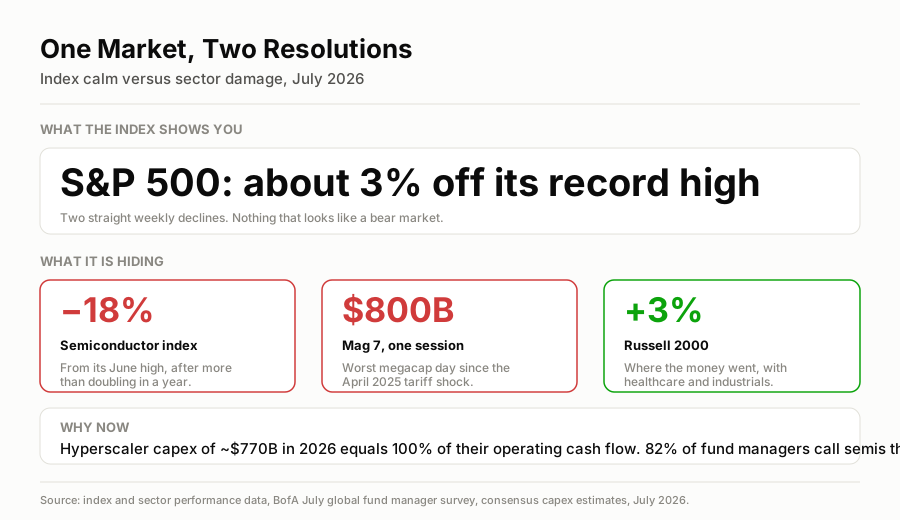
Same market, two resolutions. The index is a weighted average, and averages hide the bodies.
The Rotation, Measured
Rotation is an abstract word for a very concrete thing: the market selling one group to buy another, on the same day, with the same money.
What got sold. Semiconductors, hardest. The SOX has more than doubled over the past year, so a 18% drawdown from June still leaves holders far ahead, which is precisely why they're willing to sell. The Mag 7's $800 billion single-session loss was the same instinct at megacap scale.
What got bought. The Russell 2000 rose about 3% as small and mid caps caught a bid. Healthcare and industrials led the sector tables. Within tech, money didn't leave the theme so much as move down the food chain, into liquid cooling, cybersecurity and selected software: AI-adjacent businesses that benefit from the buildout without carrying the capex risk themselves.
That last detail is the tell. This is not "the market has stopped believing in AI." It's the market deciding it no longer wants to pay any price for the most obvious expression of it.
Why Now: The Capex Bill Arrived
The thing that changed isn't demand, it's arithmetic. Consensus has hyperscalers spending roughly $770 billion on capex in 2026, a figure equivalent to 100% of their cash flows from operations.
Sit with that. The largest, most profitable companies on earth are set to spend every dollar of operating cash flow on building AI infrastructure. That is either the greatest land grab in corporate history or a spending race with no margin for error, and for two years the market simply assumed the first. This month it started demanding proof, which is the AI capex reckoning we've been tracking, and it's why Wednesday's megacap prints are the real event.
Add the positioning problem: Bank of America's July fund manager survey found 82% identified semiconductors as the market's most crowded trade. When four out of five professionals agree on a position, there is nobody left to buy it and everybody available to sell it. Crowding doesn't cause the decline, but it sets the size of it.
The Bodies the Index Is Hiding
Look at what the "3% off highs" tape actually contains:
- Tesla collapsed roughly 16% over two sessions on a 1.4% operating margin.
- Memory names are down 22% to 30% from June highs, after being the year's best performers.
- Korea's KOSPI fell 8.95% in a single session, triggering a circuit breaker, with SK Hynix printing its worst day on record.
- Robinhood fell 7% on a downgrade and a crypto slide.
Every one of those is bear-market behavior. None of them is visible in the index line, because for each of them something defensive, small-cap or healthcare-shaped went up.
Is This Healthy or the First Crack?
Both readings are legitimate, and honest people hold them simultaneously.
The healthy case. Broadening is what a durable bull market looks like. An index led by seven stocks is fragile; an index where small caps, healthcare and industrials participate is sturdier. Money rotating within the market rather than fleeing it is the single most bullish structural detail available right now, and it's why the index is only down 3%.
The crack case. Rotations out of leadership have preceded plenty of real drawdowns. Leadership exists for a reason, and when the group generating the earnings growth stops working, "broadening" can be the polite name for the last buyers running out. If the capex reckoning resolves badly this week, the defensive names that have been absorbing the flows will not be big enough to hold the index up alone.
The resolution isn't philosophical. It's Wednesday through Friday, in four earnings releases.
The Playbook
- Stop reading the index as a report card on your portfolio. If you're down while the S&P is flat, you don't have bad luck, you have concentration in what's being rotated out of. Name it accurately and the decision gets easier.
- Check what you actually own, by theme not by ticker. Many investors discover they hold the same AI trade five times through different names, an ETF, and their employer's stock. That's the exposure the last month has been punishing.
- Rotations reward rebalancing, not prediction. Trimming what tripled and adding to what lagged is the mechanical version of "sell high, buy low," and it doesn't require you to call the top.
- For long-term holders this is noise with a scary soundtrack. A 3% index drawdown is not an event, and time in the market beats timing it precisely during weeks that feel like this one.
The Options Angle
- Index options are the wrong hedge for a rotation. SPY puts protect against the index falling, and the index isn't falling. If your pain is concentrated in semis, hedging with SPY is paying for insurance on a house that isn't burning.
- Single-name or sector hedges match the actual risk, at the cost of higher premium. That cost is the honest price of concentrated exposure, and noticing you can't afford it is useful information about your position size.
- Elevated dispersion is why an iron condor on the index has been working while single-stock premium sellers got run over. The index pins; the components go wild. Sell the calm thing, not the violent one.
- If you're holding winners you can't bring yourself to trim, a covered call monetizes exactly the elevated volatility this rotation created.
The One-Line Read
The S&P 500 is 3% off its high while semiconductors sit 18% below June and the Mag 7 lost $800 billion in a session, because this is a rotation rather than a decline, and a cap-weighted index nets the two halves against each other; it feels like a bear market because for anyone who owned the crowded AI leadership it genuinely is one, and whether that stays contained gets decided by four earnings reports this week, not by the index line.
More on Markets Today
$SPY · 2026-07-27
Stock Market Today, July 27, 2026: Dow Climbs 262 Points on Cheap Oil While Nvidia's 5% Drop Sinks the Nasdaq
$SKHY · 2026-07-27
KOSPI and SK Hynix After the Crash: Buy the Dip, Buy Puts, Sell Cash-Secured Puts, or Wait?
$SPY · 2026-07-27
Stock Market Today, July 27: Stocks Opened Green and Gave It Back. The Sell-Off Was Underneath.
The Sunday Setup
Enjoyed this breakdown? Don’t miss the next market setup.
Get deep-dive analyses delivered to your inbox every Sunday. Free, and built for retail investors.
Comments
0 totalNo comments yet. Be the first to drop a take.