Samsung Q2 Earnings, July 30: A Record ₩89.4 Trillion Profit the Market Has Already Sold Twice
Samsung reports full Q2 results at 10:00am KST on Thursday July 30, after guiding to a record ₩89.4 trillion operating profit and watching the stock fall anyway. The four segment lines that matter.
TL;DR
- Samsung publishes full Q2 results with segment detail at 10:00am KST on Thursday, July 30, which is 9:00pm ET Wednesday, July 29. The preliminary numbers have been public since July 7.
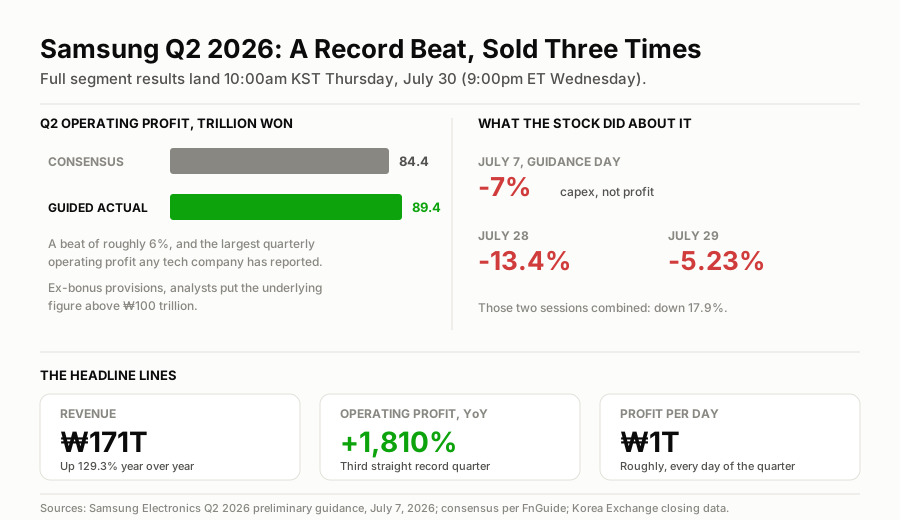
- Those preliminaries: revenue about ₩171 trillion, operating profit about ₩89.4 trillion. Operating profit beat the roughly ₩84.4 trillion FnGuide consensus by about 6%.
- That is up 1,810% year over year, the third consecutive record quarter, and the largest quarterly operating profit any technology company has ever reported, ahead of Nvidia and Apple. Roughly ₩1 trillion of operating profit per day.
- The stock fell 7% on the day it was announced, then 13.4% on July 28 and 5.23% on July 29. A record that big, sold that hard, is the single strangest fact in this market.
- Thursday adds the only thing that matters now: the segment breakdown. Whether memory carried the beat, and what HBM did inside it, decides whether SK Hynix's miss was a company problem or a cycle problem.
More on $SSNLF: Samsung's New Foldables Are Aimed at Apple, Not Your Wallet: The Z Fold 8 Wide, Explained →
What Time Does Samsung Report Earnings?
10:00am Korea Standard Time on Thursday, July 30, with the investor relations conference call at the same hour. For US readers that is 9:00pm ET on Wednesday, July 29, which puts it roughly five hours after the Fed decision and a few hours after Microsoft and Meta report.
Samsung splits its reporting in two, which confuses people every quarter. The preliminary guidance on July 7 gave you revenue and operating profit and nothing else. The full release on July 30 gives you the divisional breakdown: how much came from memory, how much from foundry, how much from phones. The headline is old news. The composition is not.
The Board
The biggest quarterly operating profit in the history of the technology industry, and a share price chart that looks like a warning.
What We Already Know
- Revenue: ₩171 trillion, up 129.3% year over year.
- Operating profit: ₩89.4 trillion, up 1,810.3% year over year.
- Versus consensus: roughly ₩84.4 trillion was expected. A beat of about 6%.
- Records: the third straight all-time high quarter, and the largest quarterly operating profit ever reported by any technology company.
Two footnotes that get lost in the headline:
Excluding the performance bonus provisions, analysts estimate underlying operating profit would have exceeded ₩100 trillion. Samsung paid its staff out of a boom, which lowers the printed number and tells you something about how confident management felt when they set those provisions.
Revenue was the softer line. Depending on whose consensus you use it either modestly beat (FnGuide's ₩169.4 trillion) or modestly missed (a wider street average nearer ₩173.3 trillion). It is not the clean beat the profit line was, and in a market this jumpy, "depends whose consensus" reads as a miss.
What July 30 Actually Adds
Four lines. Everything else on Thursday is texture.
1. Device Solutions operating profit, and the memory split inside it. This is the number. Samsung's beat came from AI memory pricing. If the memory division shows operating profit accelerating with margins expanding, then SK Hynix's shortfall was execution, mix or timing at one company. If Samsung's memory line shows the same deceleration in the second derivative, the de-rating running through the entire Korean market is correctly priced and has further to run.
2. HBM shipment commentary. Samsung passed Nvidia's HBM4 certification, confirmed publicly by Jensen Huang on June 5, 2026, and began HBM4 mass production in February. Analysts put Samsung at roughly 25-30% of Nvidia's Vera Rubin HBM4 volume, with its overall HBM bit share climbing from about 20% in 2025 to 28% in 2026 while SK Hynix slips from 59% to about 50%. If those numbers show up in the segment detail, Samsung is taking share in the only memory product that matters. That is a very different story from the one the tape is telling.
3. Capex guidance. This is what actually knocked the stock 7% on July 7: not the profit, the spending required to keep earning it. A memory supercycle that demands ever-larger capex to service is a worse business than one that does not, and the market said so immediately. Watch the 2026 capex figure and any 2027 hint.
4. Any read on Chinese competition. Management's language on CXMT and commodity DRAM pricing is the closest thing to an authoritative answer on the threat that has driven this entire selloff. Samsung competes with CXMT far more directly than SK Hynix does, because Samsung has more commodity DRAM exposure. If anyone is going to sound worried, it is them, and if they do not sound worried, that is information.
Why a Record Profit Keeps Getting Sold
Three reasons, and none of them is "the numbers are fake".
The multiple, not the earnings. Samsung more than doubled in the first half of 2026. At the June peak, investors were paying a boom multiple on boom earnings, which is the compounding mistake every cycle makes at the top. Earnings delivered. The multiple is what is unwinding, and it can unwind a long way without a single estimate being cut.
Capex undercuts the record. A profit that requires enormous reinvestment to defend is worth less per won than one that does not. Samsung's July 7 reaction, up on profit and down 7% on spending, was the market pricing exactly that, weeks before the crash.
The comparison is now impossible. Operating profit up 1,810% cannot repeat. Next year's growth rate off a ₩89.4 trillion base is arithmetically brutal no matter how well the business does. Markets pay for rate of change, and the rate of change peaked in this quarter almost by definition.
Samsung vs SK Hynix: The Divergence Nobody Priced
Here is the most interesting thing on the board, and almost nobody is trading it.
Samsung beat its consensus. SK Hynix missed its consensus. Yet over July 28 and 29 they fell together, Samsung 17.9% and SK Hynix 22.9%, as if they were one instrument. On June 22, SK Hynix had overtaken Samsung as Korea's most valuable company for the first time in more than 25 years. That premium is now unwinding fast.
The market is treating these as the same asset. They are not:
- SK Hynix is the HBM pure play. Higher margin, higher share, and higher exposure to any deceleration in the single product driving the boom.
- Samsung is HBM plus commodity DRAM plus NAND plus foundry plus phones. More exposed to CXMT, less exposed to an HBM air pocket, and it just took HBM share while its rival lost it.
If Thursday's segments confirm Samsung gaining HBM share while beating on profit, the two-day correlated selloff will look like an indiscriminate liquidation, which is usually where the pair trade lives.
The Options Angle
- This is a segment-detail event, not a headline event, which caps the move. The profit number has been public since July 7. There is no ₩89.4 trillion surprise available on Thursday. That argues against paying up for a straddle: you would be buying volatility into an event whose biggest variable is already printed.
- Samsung has no clean US options market. This is the practical constraint most readers hit. Samsung does not have a US listing like SK Hynix's SKHY ADRs do; it trades in Seoul and, for US accounts, mainly as the thinly traded SSNLF over-the-counter line, which has no usable options chain and a spread that will eat any edge you think you have. If you want to express a Samsung view from a US brokerage account, your realistic instruments are EWY (the Korea ETF) or the memory complex proxies, not Samsung itself.
- EWY expresses this at about half strength, and that is the price of doing it from a US account. You get Samsung and SK Hynix plus everything else in the index. Diluted upside, but no overnight single-stock gap risk from a headline printed while you were asleep.
- The pair is the sharper idea than the direction. Long Samsung against short SK Hynix, if your broker gives you access to Seoul, expresses "the market wrongly treated a beat and a miss identically" without needing the whole memory complex to bottom. Most retail accounts cannot do this, which is precisely why the mispricing persists.
- Do not sell premium ahead of the call. Three catalysts land inside 24 hours: the Fed, Microsoft and Meta, then Samsung's segments. Selling volatility into a stack like that is picking up nickels in front of a steamroller you can see on the timetable. The hour-by-hour version is here.
What Would Change the Read
A memory division showing operating margin expansion with HBM shipments up sequentially turns this from a cycle top into a rotation between two Korean chipmakers, and it makes the Kospi's 39.7% drawdown look like the overshoot the bulls need it to be.
A memory division showing margin compression, or capex guided materially higher without a shipment number to justify it, confirms that SK Hynix's miss was the industry and not the company. In that world the de-rating is only partly done and the right response is patience, not courage.
One release, two very different Augusts.
The One-Line Read
Samsung is about to confirm the largest quarterly operating profit any technology company has ever earned, and the market has already sold it three separate times, because the argument stopped being about whether the money is real and became about what a won of AI memory profit is worth when it costs this much capex to make and the growth rate can only fall from here; Thursday's segment table is the first honest answer anyone will get.
Next up:Fed decision, Tuesday →
More on $SSNLF
Updated Every Saturday
The Week Ahead
Every earnings date, Fed event and setup for the current trading week, on one page.
Refreshed Weekly
Earnings Calendar
Who reports next, when, and what consensus and the whisper expect.
The Week-Ahead Brief
Don’t miss next week’s setups. Get the Sunday brief.
Latest issue, Sep 7“Week ahead in the stock market...”
Every Sunday: next week’s earnings dates, Fed days and the trades worth watching, from the same desk that writes the week-ahead hub. Free, built for retail investors.