SK Hynix Q2 Earnings: A Record ₩60.5 Trillion Profit, a Miss Anyway, and the Whisper That Called It to Within 0.2%
SK Hynix posted a record ₩60.54 trillion Q2 operating profit at a 76% margin and still missed the ₩64.1 trillion consensus. SKHY hit a record low near $130. What the print says about the memory cycle.
TL;DR
- SK Hynix reported Q2 2026 revenue of ₩79.32 trillion and operating profit of ₩60.54 trillion, both all-time records, both below consensus of roughly ₩84.1 trillion and ₩64.1 trillion.
- Operating margin came in at 76%. Operating profit rose 557% year over year and 61% sequentially, the fifth consecutive record quarter.
- One quarter of profit was 28% larger than the company's entire previous annual record of ₩47.2 trillion, set in 2025.
- The stock fell anyway: SK Hynix down 9.61% in Seoul, the SKHY ADRs to a record low near $130, roughly 13% below the $149 IPO price and 23% below the $170 debut open.
- The ₩60.4 trillion brokerage whisper that crashed the Kospi on July 13 came in at ₩60.54 trillion. It was off by 0.2%. The sellers who broke that market were working from a number that turned out to be right.
More on $SKHY: Kospi Enters a Bull Market, and Is Still 27% Below Its Record →
Did SK Hynix Beat or Miss?
It missed, by about 5.6% on operating profit and 5.7% on revenue, while simultaneously posting the largest quarterly profit in the company's 43-year history.
Both halves of that sentence are true and neither cancels the other. A record that falls short of expectations is still a record, and expectations are still what you get paid on. Anyone telling you this print was unambiguously good or unambiguously bad is selling you a position, not a reading.
The Board
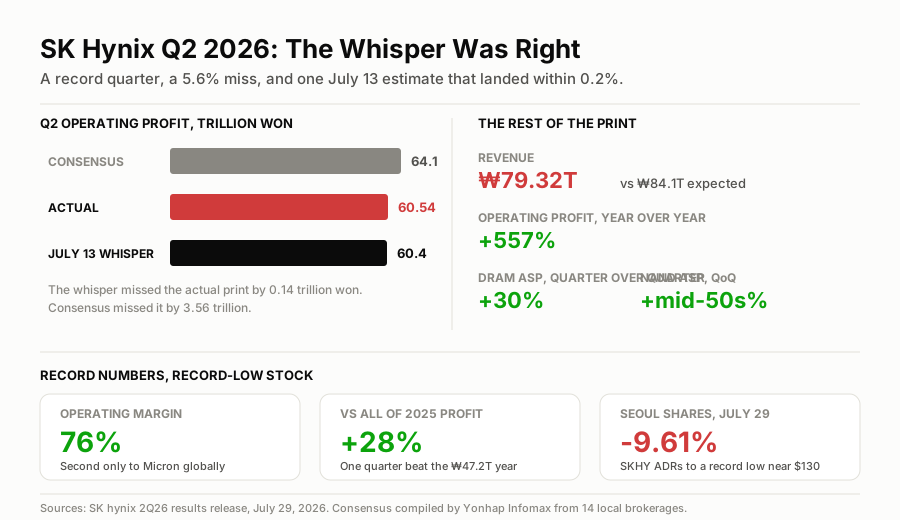
Three bars. The one on the right was published on July 13 by a single brokerage and nobody believed it.
The Numbers, In Full
- Revenue: ₩79.32 trillion against roughly ₩84.1 trillion expected. A miss of 5.7%.
- Operating profit: ₩60.54 trillion against roughly ₩64.1 trillion expected. A miss of 5.6%.
- Operating margin: 76%. Second only to Micron worldwide.
- Operating profit, year over year: up 557%. An all-time record.
- Operating profit, quarter over quarter: up 61%. The fifth consecutive record quarter.
Underneath the headline, the pricing detail is the part worth reading twice:
- DRAM: bit shipments up a high single-digit percentage sequentially, average selling prices up roughly 30% quarter over quarter.
- NAND: bit shipments up in the mid-teens percent, average selling prices up in the mid-50s percent quarter over quarter.
- Customers: long-term supply agreements now signed with 10 customers.
- 2026 outlook: DRAM demand growth of mid-20% year over year, NAND high-teens percent.
- The awkward footnote: smartphone and PC sales were temporarily adjusted downward because customers could not secure memory volumes. Read that as a company turning away business it physically cannot supply.
Consensus was compiled by Yonhap Infomax from 14 local brokerages, the same set we used in the earnings preview.
The Whisper Was Right
Rewind to July 13. A single Korean brokerage published an estimate of ₩60.4 trillion operating profit against a street at roughly ₩65 trillion. The Kospi fell 8.95% into a circuit breaker. SK Hynix had its worst day on record. The US memory complex gapped down in sympathy. And the consensus reaction, ours included, was that one analyst's spreadsheet had triggered an outsized positioning flush.
The print landed at ₩60.5426 trillion.
That analyst was wrong by 0.14 trillion won, or 0.24%, on a number nobody else came within 4 trillion of. Sit with what that implies. The market spent sixteen days deciding whether to believe a forecast that turned out to be nearly exact, and spent most of those days deciding not to.
We set this print up as Test A in the thesis framework: the event that would decide whether the memory selloff was positioning or prophecy. It was prophecy. That is not a comfortable thing to write after arguing the dip was buyable, but the falsification condition was stated in advance and it tripped, so the call was wrong and the framework did its job.
What Was Actually Good In Here
The bear case does not get to have all of it. Three things in this report are genuinely strong, and they are the reason this is a de-rating rather than a collapse:
A 76% operating margin is not a cycle rolling over. Companies at the end of a boom do not print margins like that. They print margin compression first and revenue declines second. Neither happened.
Pricing is still accelerating, not decelerating. DRAM ASPs up 30% and NAND ASPs up in the mid-50s quarter over quarter is a supply shortage doing exactly what a supply shortage does. If the memory cycle were breaking, this is the first line that would crack, and it is the strongest line in the release.
Ten long-term supply agreements. The knock on memory has always been that it is a commodity sold spot into a hog cycle. Ten contracted customers is the opposite of that, and it is the structural change high-bandwidth memory has made to this industry.
What the Market Actually Repriced
So why did a stock with a 76% margin and 557% profit growth fall 9.61%?
Because none of those numbers were the bet. The bet was the second derivative. SK Hynix was priced for an AI memory boom that keeps accelerating away from expectations, quarter after quarter. It delivered a boom that merely grew enormously. Those are different assets and they carry different multiples.
Stack that on the two live threats and the de-rating is coherent even if it is violent:
- CXMT raised about $8.6 billion for DRAM capacity and debuted up 466% in Shanghai, putting a fourth funded player into commodity DRAM.
- Chinese domestic immersion DUV lithography is reportedly moving to roughly 5 machines in 2026 and 20 in 2027, which attacks the tooling moat rather than the chip.
- And the ADR carries its own separate problem: SKHY still trades at a premium of about 22% to the Seoul shares, a gap we unpack in the ADR premium explainer.
Neither China threat touches an HBM roadmap in 2026. Both touch the multiple today. That distinction is the entire investable question.
The Options Angle
- The binary is gone, and that changes the instrument. Our standing advice was to do nothing before the print and sell cash-secured puts after it cleared. The print has cleared. The event premium is now bleeding out of the chain whether you were right or wrong about direction.
- Selling puts is now live, but strike it below the post-print low, not below Monday's price. The whole logic of the wheel here is getting paid elevated volatility to name a purchase price under a level that has already absorbed capitulation. A record low near $130 is that level. $143 is not.
- Respect that this chain is three weeks old. SKHY listed on July 10. There is no trading history to build support from, the bid-ask is wide, and lock-up expiries are still ahead. Every one of those argues for a smaller position than your conviction wants, and for spreads over naked premium.
- Do not buy puts here. You are late to your own idea. Implied volatility is bid precisely because the crash already happened, and the scheduled catalyst that justified the premium has now passed. Buying protection the morning after the event is paying peak price for expired insurance.
- The correlation trade may be better than the single name. A stabilising SKHY un-flushes MU, SNDK and EWY at the same time, and their chains are older, deeper and cheaper to trade. The valuation version of that argument is in the MU and SNDK breakdown.
What Would Change the Read
Update, August 3: the shareholder return announcement this release did not contain. SK Hynix said nothing about buybacks or dividends alongside a record quarter, and that silence was legally required rather than chosen. SEC Rule 174 keeps prospectus delivery obligations alive for 25 days after a registered offering, and SKHY listed on July 10, so the window closes on the night of August 4 Korea time. The company confirmed it could not disclose material information absent from the offering document. What that unlocks, and why the ₩100 trillion figure attached to it is a report SK Hynix formally denied.
Samsung's full segment breakdown on Thursday, July 30 at 10:00am KST. Samsung's preliminary guidance of ₩89.4 trillion operating profit beat its ₩84.16 trillion consensus. If the segments show memory carrying that beat with HBM shipments accelerating, then SK Hynix's shortfall is a company problem, not a cycle problem, and this print gets re-read entirely. If Samsung's memory division shows the same deceleration, the de-rating has further to run. Our preview is here.
The One-Line Read
SK Hynix earned more in three months than it did in the whole of its previous record year, at a margin almost no company on earth can match, and the stock hit an all-time low on the news, because the market was never paying for a great quarter; it was paying for a quarter great enough to keep outrunning its own expectations, and this one, by 0.2% shy of exactly what one analyst warned sixteen days ago, did not.
Next up:Fed decision, Tuesday →
More on $SKHY
Updated Every Saturday
The Week Ahead
Every earnings date, Fed event and setup for the current trading week, on one page.
Refreshed Weekly
Earnings Calendar
Who reports next, when, and what consensus and the whisper expect.
The Week-Ahead Brief
Don’t miss next week’s setups. Get the Sunday brief.
Latest issue, Sep 7“Week ahead in the stock market...”
Every Sunday: next week’s earnings dates, Fed days and the trades worth watching, from the same desk that writes the week-ahead hub. Free, built for retail investors.