Stock Market Today, July 27: Stocks Opened Green and Gave It Back. The Sell-Off Was Underneath.
Stock market today July 27: Nasdaq futures ran up 1.4% on a 6.3% oil crash, then the open faded and memory broke. Why Micron, SanDisk and SPCX sold anyway.
TL;DR
- The premarket was the best setup this tape has had in weeks: Nasdaq 100 futures up 1.4%, S&P 500 futures up 0.9%, Dow futures up 0.8% at 52,738, all of it paid for by Brent crashing 6.3% to settle at $85.87 after the US and Iran paused strikes.
- Stocks opened on that script. The Dow was up 1%, the S&P 500 up 0.8%, the Nasdaq Composite up 1% right after the bell. Then the buying stopped. By the close the S&P 500 held just +0.02% at 7,413.18 and the Nasdaq Composite finished red, down 0.18% at 24,932.08, giving back the entire opening gain.
- The real story is not the index. It's what got sold inside a green tape: memory. Micron was up 3.21% at $950.54 premarket on China's CXMT debuting up 466%, and that same debut is the bear case, because CXMT just raised $8.6 billion to build DRAM capacity.
- SPCX fell 2.68% to $115.07, now 49% below its $225.64 June high, with first earnings August 4 and a 911.5 million share lock-up expiring August 6.
- The Fed lands Wednesday, then Microsoft, Meta, Apple and Amazon. Nobody wants to be long into that, which is exactly why gaps are fading.
Why Did Stocks Open Green and Then Fade Today?
The short answer: the good news was geopolitical and the bad news was structural, and the market spent the morning deciding which one it actually gets paid for.
The good news was real. The US and Iran paused military strikes over the weekend, Tehran opened talks with Oman about the Strait of Hormuz, and Brent crude fell 6.3% to settle at $85.87, down from as high as $102 last week. Cheaper oil is a direct inflation input, and an inflation input that cooperates two days before a Fed decision is worth a gap up. We flagged that setup in the premarket note this morning.
The bad news is that nothing about the actual week changed. There is still a rate decision Wednesday, still four megacaps reporting into a market that has decided AI capex is a cost rather than a virtue, and still a memory complex that spent all of July breaking. An oil-driven gap up does not fix any of that. It just gives people a better price to sell at.
That's the mechanic behind a green-to-flat morning: an overnight gap built on one variable meets a cash session that has to price all of them.
The Board
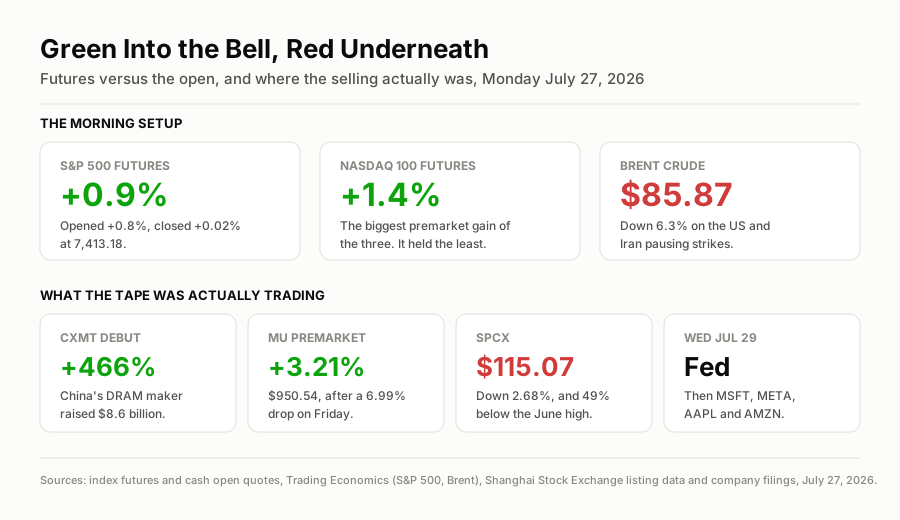
Everything on the top row was a reason to buy. Everything on the bottom row is why the buying stopped.
The CXMT Debut Cuts Both Ways, and the Second Way Is the Problem
Here is the single most important number of the day, and it did not happen in America. ChangXin Memory Technologies (CXMT) listed in Shanghai and closed its first session up 466% at 49 yuan against an 8.66 yuan IPO price, briefly trading above 54 yuan. It raised 57.92 billion yuan, or about $8.6 billion, the largest mainland Chinese semiconductor offering on record and Asia's biggest IPO of 2026.
At roughly 3.3 trillion yuan (about $488 billion), CXMT is now the most valuable company listed on a mainland Chinese exchange. It passed ICBC. A DRAM maker most Western investors had never heard of a year ago is worth more than China's largest bank.
The premarket read that as bullish. If the market will pay $488 billion for the world's fourth-largest DRAM producer, one holding roughly 7.67% global DRAM share in 2025, then Micron at a fraction of that multiple looks cheap. MU traded up 3.21% to $950.54 before the bell, off a Friday close of $920.95 that was itself a 6.99% drop from $990.21.
Then the open arrived with the other half of the sentence. CXMT did not just get a valuation. It got $8.6 billion in cash whose stated purpose is scaling DRAM production, in an industry where the entire 2026 bull case is that supply cannot keep up with AI demand. You cannot celebrate a competitor's valuation and ignore its balance sheet. We walked through what CXMT actually is here, and what it did to MU's chart the first time here.
The bull rebuttal is legitimate and worth stating plainly. CXMT competes in commodity DDR4, DDR5 and LPDDR for phones and PCs, not in high-bandwidth memory, where the AI margins live. Analysts peg it as roughly four years behind SK Hynix in HBM. Morningstar sees its global DRAM share reaching about 10% in 2026, mostly in the low-margin end. Micron, meanwhile, has $22 billion in supply commitments from 16 strategic customers carrying take-or-pay clauses and pricing floors, which is exactly the kind of contract structure designed to survive a price war.
The bear rebuttal to the rebuttal: commodity DRAM sets the marginal price for everything, and a well-funded fourth supplier at the bottom of the stack eventually compresses the top of it.
The Analyst Notes Nobody Wanted on a Fed Week
Two pieces of sell-side work are doing quiet damage to the memory trade, and they landed within days of each other.
Morgan Stanley's Shawn Kim, who runs Asia-Pacific and Europe technology research, argued on July 21 that the memory boom is approaching an inflection point, with contract prices peaking in Q4 2026 and earnings upgrade momentum already showing fatigue. That is not a crash call. It's worse for a momentum trade: it's a timer.
Susquehanna's Mehdi Hosseini cut his SanDisk price target to $3,050 from $3,250 after the firm found errors in its own financial model that had overstated revenue and earnings. He kept a Positive rating. The number moved anyway, and in a group this crowded, a mechanical downgrade reads the same as a fundamental one.
The counterweight is that Morgan Stanley's Joseph Moore called the memory decline a "compelling entry point" on July 20. Both notes are from the same firm. That tells you how genuinely unresolved this is.
Context for anyone new to the trade: Micron, Samsung and SK Hynix have each fallen more than 20% from their late-June highs. The best-performing sector of 2026 is in a technical bear market while still up enormously on the year. Both things are true, and which one you emphasize is a position, not an analysis. We marked our own memory call to market here.
SPCX Has a Calendar Problem, Not a Sentiment Problem
SpaceX fell 2.68% to $115.07 from a $118.24 close, which makes it one of the few large names red in a green tape for reasons that have nothing to do with oil or memory.
The stock is now roughly 49% below the $225.64 high it printed June 16, four days after its debut, and well under its $135 IPO price. We wrote the full valuation teardown when it first broke issue at $126.76. It has lost another 9% since.
The reason it keeps bleeding is two dates:
- August 4: first earnings as a public company. Consensus looks for roughly $6.9 billion in revenue, up 47% quarter over quarter, against a net loss of about $0.28 per share.
- August 6: the first lock-up expiry, freeing roughly 911.5 million insider shares, worth about $116 billion at current prices.
That second number is the whole story. A supply event of that size two days after a loss-making print is not something a market prices on the day it happens. It gets priced in advance, one small down day at a time, which is precisely what a 2.68% drift lower on a strong morning looks like. Cathie Wood's Ark has been buying into it, adding $21.3 million on the way down.
The Week Is the Real Risk
Everything above is Monday noise compared to what's scheduled.
- Wednesday, July 29: the Fed decision, and the first genuinely hard meeting of the Warsh era. We laid out why it's his first real test. Today's oil crash lowers hike risk at the margin. It does not remove it.
- Wednesday night: Microsoft and Meta, back to back.
- Thursday: Apple, where the China memory question is a live wildcard.
- Friday: Amazon, and the AWS growth versus capex bill question.
Collectively the megacaps are expected to post earnings growth of about 26.5%. The bar is not low. Our full week-ahead map is here.
The Options Angle
A morning that gaps up and fades is a specific volatility signature, and options price it differently than direction traders do.
- Fading gaps into event risk is the tell. When a market refuses to hold a 1.4% futures gain two days before a Fed decision, sellers are using strength as liquidity. That's a supply signal, not a sentiment one.
- Implied volatility is expensive for a reason this week. A Fed decision plus four megacap prints in 72 hours is priced in. Buying premium here means paying for a move that has to exceed what everyone already expects, and then surviving the IV crush after Wednesday.
- If you own memory and can't decide, the middle path exists. Selling a covered call against a Micron or SanDisk position gets paid by the same elevated volatility that's making you nervous, caps your upside if the CXMT read-through turns out to be bullish, and does nothing to protect you if the supply thesis breaks. It is a compromise, not a hedge. Know which one you're buying.
- SPCX into August 4 and August 6 is a two-catalyst structure, not a one-way bet. A straddle spanning both dates is the honest expression of "something big happens and I don't know which way." It is also the expensive one, because the market can read a calendar too.
- The cheapest trade is no trade. Monday before a Fed week is a positioning session. Positioning sessions punish conviction and reward patience.
The One-Line Read
The market got handed a gift this morning in the form of $86 oil and a 466% Chinese IPO, spent forty-five minutes enjoying it, and then remembered that the same IPO just handed a competitor $8.6 billion, the Fed meets Wednesday, and four megacaps report after that. A 1.4% futures gain that ends at flat is not a rally failing. It's a market that would rather be flat than wrong.
More on Markets Today
$SPY · 2026-07-27
Stock Market Today, July 27, 2026: Dow Climbs 262 Points on Cheap Oil While Nvidia's 5% Drop Sinks the Nasdaq
$SKHY · 2026-07-27
KOSPI and SK Hynix After the Crash: Buy the Dip, Buy Puts, Sell Cash-Secured Puts, or Wait?
$SPY · 2026-07-27
SPY Is Only 3% Off Its Record. So Why Does It Feel Like a Bear Market?
The Sunday Setup
Enjoyed this breakdown? Don’t miss the next market setup.
Get deep-dive analyses delivered to your inbox every Sunday. Free, and built for retail investors.
Comments
0 totalNo comments yet. Be the first to drop a take.