Boeing (BA) Lost $428 Million and the Stock Went Up 4.8%. The Number That Explains It Is Free Cash Flow.
Boeing rose 4.8% above $220 after a Q2 2026 net loss of $428 million, because free cash flow came in at positive $631 million against an expected $177 million burn. Why cash beat profit.
TL;DR
- Boeing rose 4.8% above $220 on Wednesday July 29 despite reporting a Q2 2026 net loss of $428 million, or $0.67 a share.
- The loss actually narrowed. A year ago it was $612 million, or $0.92 a share. But nobody bought the stock for that.
- They bought it for cash. Free cash flow came in at positive $631 million against a consensus expecting a $177 million burn, and against a $200 million burn in the same quarter last year. That is a roughly $800 million swing versus expectations.
- Revenue rose 8% to $24.56 billion. Commercial deliveries rose 14% to 171 aircraft from 150. 737 MAX production is running at 47 a month with further increases planned.
- The backlog hit a record $715 billion, including more than 6,200 commercial aircraft. Certification flight testing is complete for the MAX 7 and MAX 10, with certification still expected in 2026 and first deliveries in 2027.
More on $BA: Boeing Q2 2026 Earnings Preview: The Loss Is Already Priced. The Cash Number Is the Trade. →
Why Is Boeing Stock Up After a Loss?
For a company in a turnaround, free cash flow is the scoreboard and net income is the noise, and Boeing generated $631 million of free cash flow in a quarter Wall Street had modelled as a $177 million burn.
That is the entire trade. A loss-making aerospace manufacturer that stops consuming cash has changed its risk profile even if it has not changed its income statement. Every quarter of positive cash flow is a quarter Boeing does not need to raise money, dilute shareholders or add to a debt load that has defined the story since 2019.
The $428 million net loss was inflated by cost overruns on programmes including Air Force One. Those are fixed-price defence contracts where the losses are already known and mostly booked. They tell you nothing about whether the commercial business is working.
The commercial business is working.
The Board
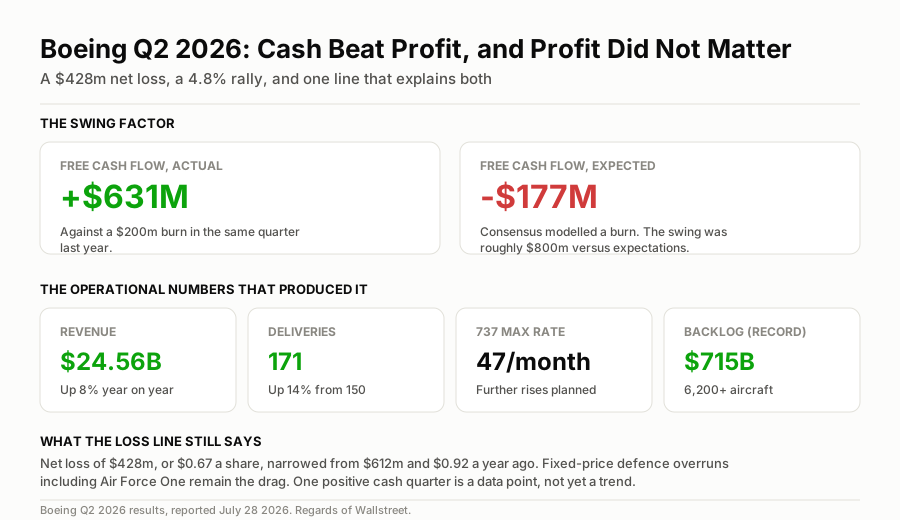
The loss narrowed. The cash flipped. Only one of those moves a turnaround stock.
Where the Cash Came From
Deliveries. That is almost the whole answer, and it is why the operational numbers matter more than the accounting ones here.
Boeing gets paid the bulk of an aircraft's price on delivery. Planes sitting in inventory are cash already spent and cash not yet collected. So the delivery count is not a vanity metric, it is the cash conversion mechanism.
171 commercial aircraft delivered, up 14% from 150. Revenue up 8% to $24.56 billion. 737 MAX production at 47 a month with more planned. Each of those is the same fact stated three ways: Boeing is converting inventory into cash faster than it is burning it.
The forward piece is certification. Flight testing is complete for both the MAX 7 and MAX 10, with certification still expected in 2026 and first deliveries in 2027. Those are two aircraft with years of accumulated orders that cannot be delivered, and therefore cannot be paid for, until a regulator signs. When they do, the delivery count steps up again.
Against that sits a record $715 billion backlog with more than 6,200 commercial aircraft. Boeing's problem has never been demand. It has been the ability to build and deliver what it already sold.
The Bear Case, Which Is Not Small
- One quarter of positive free cash flow is not a trend. Boeing has produced good quarters before and then given them back. The claim "the turnaround is real" needs three or four of these consecutively, not one.
- Fixed-price defence remains a running wound. The Air Force One overruns are the visible version. There is no market mechanism that fixes a bad fixed-price contract, only time and completion.
- Certification timing is out of Boeing's hands. "Still expected in 2026" has been said before about MAX 7 and MAX 10. A slip pushes 2027 deliveries and the cash that comes with them.
- Production rate increases are exactly where quality problems appear. Boeing's last decade says the risk of going faster is not schedule risk, it is a grounding.
- You are buying a company that still loses money. At above $220, the valuation prices a recovery, not a result. If the cash flow flips negative again next quarter, there is no earnings floor underneath.
Is Boeing a Buy Here?
Yes for investors with a genuine multi-year horizon, no for anyone who needs it to work this year.
The bull case is straightforward and it just got more credible: a duopoly business with a $715 billion backlog, a delivery rate rising 14%, two aircraft about to be certified, and a cash flow line that just turned positive a year earlier than the consensus modelled. That combination re-rates the stock if it persists.
The bear case is that everything above depends on execution, and execution is the exact thing Boeing has failed at for six years running.
Our read: own it as a recovery position sized for volatility, not as a core holding. The single metric that decides whether you keep it is free cash flow, quarter by quarter. Two more prints like this one and the thesis is proven. One negative quarter and you have learned the turnaround is still a hope. Do not let the record backlog talk you into a position size the loss statement cannot support.
Why the Tape Helped
Boeing reported into the same rotation that lifted the rest of the Dow this week. The Nasdaq 100 entered a correction on Wednesday, sitting 10% below its June peak of 30,660 after four straight sessions of chip selling, while the Dow closed Tuesday up 0.62% at 52,534.84. Money leaving AI hardware has been landing in industrials, and Boeing gave it a reason. The mechanics are in the Nasdaq 100 correction piece, and the same current pushed Ford and Sherwin-Williams higher on the same days.
The Options Angle
- At above $220, one contract controls roughly $22,000 of stock. Workable for a mid-sized account, expensive for a small one.
- Cash-secured puts are the cleaner expression of the bull case than buying call options outright: you get paid to set an entry below the current price, and Boeing's elevated volatility means the premium is worth collecting.
- Post-earnings implied volatility is deflating, so chasing calls after a 4.8% gap pays full retail for a move that already happened.
- Covered calls are defensible for existing holders but think twice about the strike. If MAX 7 and MAX 10 certification lands in 2026, the upside gap is the whole reason to own this, and a tight call caps the exact scenario you are being paid to wait for.
The One-Line Read
Boeing rose 4.8% on a $428 million loss because free cash flow came in $800 million better than expected while deliveries rose 14% into a record $715 billion backlog: that is the turnaround finally showing up in the only line that matters, and it needs three more quarters like it before anyone should call it proven.
Next up:Fed decision, Tuesday →
More on $BA
Updated Every Saturday
The Week Ahead
Every earnings date, Fed event and setup for the current trading week, on one page.
Refreshed Weekly
Earnings Calendar
Who reports next, when, and what consensus and the whisper expect.
The Week-Ahead Brief
Don’t miss next week’s setups. Get the Sunday brief.
Latest issue, Sep 7“Week ahead in the stock market...”
Every Sunday: next week’s earnings dates, Fed days and the trades worth watching, from the same desk that writes the week-ahead hub. Free, built for retail investors.