Microsoft Is Up 8% After Hours. Can It Save Tech Stocks?
MSFT jumped 8% on $678B of contracted backlog, hours after the Dow fell 2.19%. Nasdaq 100 futures are up only 0.7%. What Microsoft can rescue, and the two things it cannot.
TL;DR
- Microsoft is up about 8% in extended trading, building through the evening from roughly 3% on release, after commercial RPO grew 84% to $678 billion and Azure accelerated to 43%.
- It happened hours after the worst day in months: the Dow fell 2.19% to 51,594.14, the Nasdaq Composite fell 1.74% to more than 10% below its record, and the 30-year Treasury pushed to 5.193%.
- The most useful number tonight: Nasdaq 100 futures are up only about 0.7%. Microsoft is the largest weight in that index and it is up 8%. The rest of the complex is barely moving.
- What Microsoft can rescue is one specific thing: the argument that AI capex has no receipts. It produced $678 billion of them, and 25% growth even excluding OpenAI, which closes the circularity objection too.
- What it cannot rescue: the memory cost squeeze now hitting everyone who buys chips rather than sells them, and a 30-year yield above 5%, which is a discount-rate problem no earnings beat can touch.
More on $MSFT: Microsoft Just Had the Biggest Up Day in Market History. Is MSFT a Buy 12% Below the High? →
Can Microsoft Save Tech Stocks?
It can save the AI capex trade. It cannot save the tech tape, because the two things breaking the tech tape are not things Microsoft has any control over.
That distinction is the whole article, so let us do it properly.
The Board
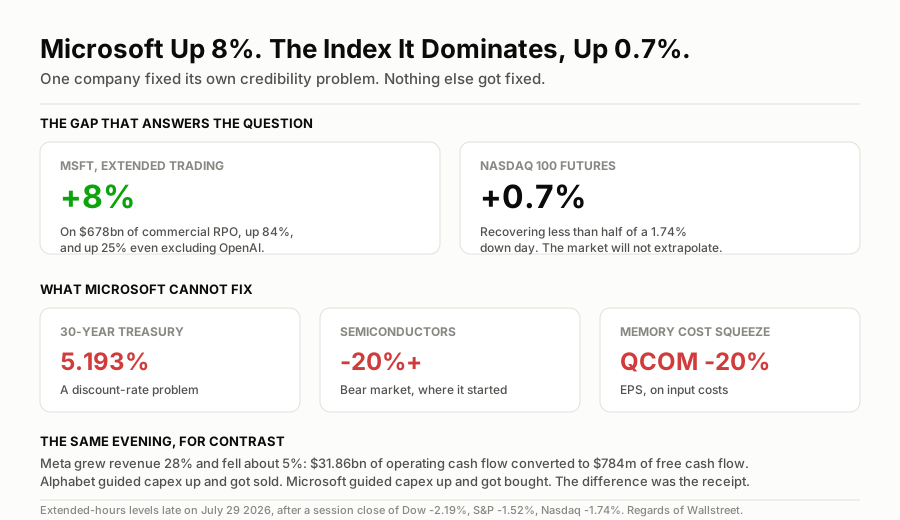
Microsoft up 8%, the index it dominates up 0.7%. That gap is the answer.
What Microsoft Genuinely Fixed
For two weeks the bear case on AI has not been "nobody wants this." It has been narrower and much harder to answer: you are spending tens of billions a quarter against a forecast, not a contract.
Alphabet made that case for the bears without meaning to. It posted the first negative free cash flow since its 2004 IPO, at -$5.9 billion on $44.9 billion of quarterly capex, then raised capex guidance to $195 to $205 billion and warned of more in 2027. Enormous spending, no visible receipt. That print is what tipped the Nasdaq 100 into a correction, as we set out this morning in the correction piece.
Microsoft answered it with an accounting line most retail investors have never looked at. Commercial remaining performance obligation: $678 billion, up 84%. RPO is signed, contracted revenue that has not yet been delivered. It is the difference between "we think customers will want capacity" and "customers have already committed to pay for capacity."
And crucially, Microsoft pre-empted the follow-up question. RPO grew 25% excluding OpenAI, with all sequential growth coming from customers outside the frontier model companies. The lazy bear response to any AI backlog is "that is just OpenAI paying Microsoft with money Microsoft gave OpenAI." That response is now closed off by disclosure.
Then the inversion. CFO Amy Hood said she sees further capex growth in fiscal 2027, citing "demand signals across our portfolio." Capex and finance leases already ran $41 billion in the quarter, up 69%.
Sit with what happened next. Alphabet guided capex up and got sold. Microsoft guided capex up and got bought 8%. The spending is not what changed. The receipt is. Our full breakdown is in the Microsoft Q4 piece.
That is a real, transferable insight for the sector. It tells every AI-levered company exactly what the market wants to see, and it tells investors what to look for. That is worth something.
The 0.7% Problem
Now the deflating part.
Nasdaq 100 futures are up about 0.7%.
Microsoft is the largest or second-largest weight in that index depending on the day. It is up 8% in extended trading. On weight alone, Microsoft's move should account for a meaningful chunk of that 0.7% by itself. Which means the rest of the index, in aggregate, is contributing close to nothing.
Compare that with what the market lost in the cash session: the Composite fell 1.74%. Futures are recovering less than half of it, on the back of the single best earnings report of the quarter from the biggest company in the group.
That is the market voting. It says: we accept Microsoft is fine. We are not extrapolating.
And Meta reported the same evening and fell about 5%, with revenue up 28% but free cash flow of $784 million against $31.86 billion of operating cash flow. Two megacaps, one night, one enormous backlog and one collapsed cash conversion. The market can tell them apart. That is discrimination, not contagion, and discrimination does not produce index rallies. Our read on that print is in the Meta breakdown.
The Two Things Microsoft Cannot Fix
1. The memory cost squeeze, which just changed sides.
For a month the memory story was about sellers: whether Micron, SK Hynix and Samsung could hold pricing against CXMT's 466% Shanghai IPO debut. Tonight it became a story about buyers.
Qualcomm reported revenue near the high end of guidance and non-GAAP EPS down 20%, then guided next quarter light, blaming rising wafer fabrication, memory, advanced packaging, assembly and test costs. Microsoft's own numbers say roughly $25 billion of its calendar-2026 capex is pure component inflation, buying no additional capacity at all.
That is a margin tax working its way through every company that puts memory in a product, and it arrives with a lag. More of those prints are coming, and Microsoft beating on Azure does nothing to stop them. See the Qualcomm breakdown for the mechanism.
2. A 30-year Treasury at 5.193%.
This is the bigger one, and it is why tonight's rally should be treated with suspicion.
The Fed held at 3.50% to 3.75% on a 9-3 vote with three members voting to hike. The short end fell: the 2-year dropped 4bp to 4.236%. The long end went the other way, with the 30-year up more than 9bp to 5.193%. That bear steepener is the bond market saying policy is behind on inflation. Full detail in tonight's Fed piece.
Long yields are the discount rate on every future dollar of earnings. A company whose value sits in cash flows arriving in 2030 gets repriced by that, mechanically, regardless of how good this quarter was. Microsoft's $678 billion backlog converts over a weighted average duration of roughly 2.5 years, and revenue you collect over years is exactly the kind of asset a rising long rate marks down. See what RPO actually is for how to read the metric.
Put plainly: Microsoft solved a credibility problem. The market has a discount-rate problem. Those are different problems and only one of them was on tonight's earnings call.
So What Would Actually Confirm a Bottom?
Four things, and none of them is Microsoft's share price.
- The 30-year back under 5.10% and holding. Until the long end settles, every rally in long-duration growth is borrowed.
- Semiconductors participating. The group is more than 20% off its highs, in a bear market, and that is where the correction originated. A tech recovery led by one software megacap while chips keep bleeding is not a recovery, it is a rotation inside a downtrend.
- Thursday's cash close above Thursday's open. Gap-up-and-fade is the signature of a bear rally. An 8% extended-hours print on thin volume is not a realised move, and we said the same thing earlier tonight when that number was 3%.
- Another company producing a receipt. Microsoft showed contracted backlog. If one more hyperscaler does the same, the "AI spending has no return" thesis is genuinely damaged. If none do, Microsoft was the exception that proves the rule.
The Playbook
- Do not buy the index on this. Nasdaq 100 futures up 0.7% against Microsoft up 8% means you would be buying the 499 companies that did not report tonight, using enthusiasm generated by the one that did.
- If you want to own the insight, own the company that demonstrated it. Microsoft went into this print down roughly 18% year to date. That is the trade with an actual thesis attached.
- Resist the "the correction is over" reflex. Corrections end when the cause is removed. The cause here is a bond market repricing inflation risk, and it got worse today, not better.
- Post-print implied volatility is collapsing across all five reporters, which makes chasing calls tonight the most expensive way to express any view. If you are staging exposure, dollar-cost averaging beats a lump entry into a tape this unresolved.
- The bull case against everything above: if the 30-year retraces and semis catch a bid on Thursday, Microsoft's print will look like the exact moment sentiment turned, and this caution will look like missing the bottom by one day. That outcome is genuinely possible. It is just not what 0.7% in the futures is currently telling you.
The One-Line Read
Microsoft did the single most useful thing any company has done this month by putting $678 billion of contracted backlog behind its capex, and it deserves the 8%, but Nasdaq 100 futures up 0.7% against a 1.74% down day is the market telling you it will not extrapolate: one company fixed its own credibility problem, and nobody fixed the 30-year Treasury at 5.193% or the memory costs now eating everyone downstream.
Next up:Fed decision, Tuesday →
More on $MSFT
$MSFT · 2026-08-10
Microsoft Just Had the Biggest Up Day in Market History. Is MSFT a Buy 12% Below the High?
$MSFT · 2026-07-30
Why Did Microsoft Pump 9%? Four Things Converged, and the Fourth One Nobody Predicted
$MSFT · 2026-07-29
What Is RPO? The Metric That Moved Microsoft 8% and How to Read It Yourself
Updated Every Saturday
The Week Ahead
Every earnings date, Fed event and setup for the current trading week, on one page.
Refreshed Weekly
Earnings Calendar
Who reports next, when, and what consensus and the whisper expect.
The Week-Ahead Brief
Don’t miss next week’s setups. Get the Sunday brief.
Latest issue, Sep 7“Week ahead in the stock market...”
Every Sunday: next week’s earnings dates, Fed days and the trades worth watching, from the same desk that writes the week-ahead hub. Free, built for retail investors.