Why Did Microsoft Pump 9%? Four Things Converged, and the Fourth One Nobody Predicted
Microsoft jumped from $390.54 to about $427.50 on July 30, its best session in memory. Azure at 43%, a $678B backlog, a 45% guide, and the capex number that came in under the fear.
TL;DR
- Microsoft closed Wednesday at $390.54 and traded around $427.50 on Thursday morning, up roughly 9.5%, with an intraday high of $429.88. That is about a 10% move at the peak, in the largest company most portfolios own.
- Four things landed at once: Azure grew 43%, commercial RPO hit $678 billion (+84%), Q1 Azure was guided to 45% against a 41.4% consensus, and capital expenditure came in below what the market had braced for.
- The fourth one is the one nobody predicted, and it is why the move is this size. The street went in expecting a $255 to $260 billion fiscal 2027 capex number. What it got eased the spending fear rather than confirming it.
- A second, separate gift arrived at 8:30am: core PCE printed +0.1% monthly and 3.3% annually, in line, which took pressure off the long end that had crushed tech the day before.
- One honest caveat, and it matters. Measured at mid-morning this was not a broad rally: the Nasdaq was up 1.6% and the Russell 2000 fell 1.61%. It broadened later, with the Nasdaq Composite closing up 2.48% at 25,049.96 as the memory complex ripped.
More on $MSFT: Microsoft Just Had the Biggest Up Day in Market History. Is MSFT a Buy 12% Below the High? →
Why Is Microsoft Stock Up Today?
Because Microsoft proved AI demand is real, proved it is contracted, guided it higher, and told the market the spending required to serve it is less frightening than feared. Any one of those is a good quarter. All four in one release is a repricing.
Here is the sequence, because the size of the move only makes sense as an accumulation.
Wednesday after the close: the numbers hit. Revenue $90.01 billion, up 18%, against $87.62 billion expected. Adjusted EPS $4.74 versus $4.24. Shares moved about 3%, then built through the evening to roughly 8% as analysts worked through the release.
Thursday premarket: the move extended to about 8.8%, near $425.
Thursday's open: it held and pushed to $429.88. Holding a gap in the cash session is the part that matters, and we said so explicitly last night: judge the gap at 11am, not 9:31am. It held.
The Board
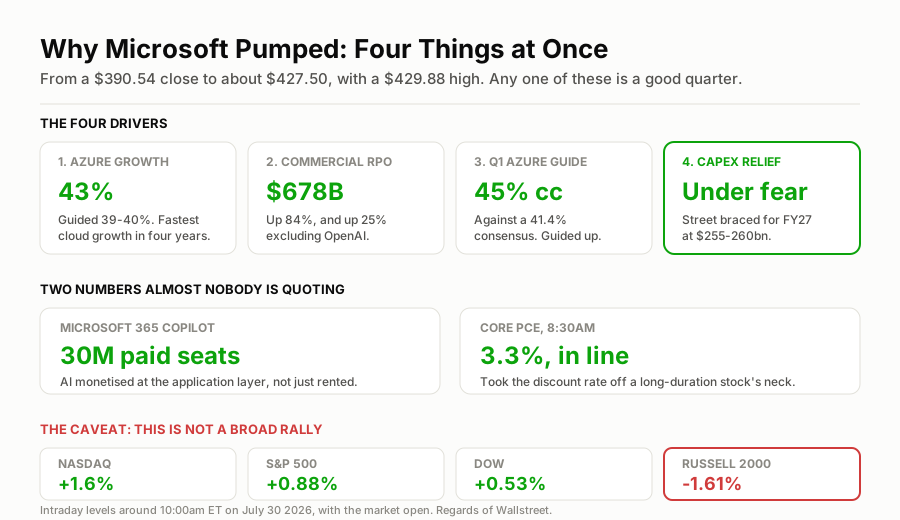
Four converging positives, and a small-cap index going the other way.
The Four Things
1. Azure grew 43%, its fastest cloud growth in four years. Against guidance of 39-40% and a consensus near 40%. It also accelerated from the prior quarter, and AI services supplied 22 percentage points of that growth, up from 16. Fiscal-2026 Azure revenue passed $100 billion for the first time, up 41%.
2. Commercial RPO reached $678 billion, up 84%. This is contracted revenue signed and not yet delivered, and it is the receipt the market had spent a fortnight demanding from everyone spending on AI. Critically it grew 25% excluding OpenAI, with all sequential growth from customers outside the frontier model companies, which closes the circularity objection. If the metric is new to you, we wrote what RPO actually is.
3. Q1 Azure was guided to 45% at constant currency, against a StreetAccount consensus of 41.4%. Guiding above an elevated bar, immediately after accelerating, is not what a company facing a demand problem does.
4. Capex came in under the fear. This is the one that turned a good reaction into a great one, and it deserves its own section.
The One Nobody Predicted
Go back 24 hours and look at what the market was actually afraid of.
Alphabet had posted the first negative free cash flow since its 2004 IPO on $44.9 billion of quarterly capex, then raised guidance to $195-205 billion and warned of more in 2027. That print tipped the Nasdaq 100 into a correction. Meta then converted $31.86 billion of operating cash flow into $784 million of free cash flow. The pattern was set: AI spending was eating cash, and every hyperscaler was going to confirm it.
Going into Microsoft's release, the street was bracketing fiscal 2027 capex at roughly $255 to $260 billion, about 35% growth on calendar 2026. The fear was a number at or above that.
Instead, the spending outlook eased the worry rather than feeding it. Capex and finance leases ran $41 billion in the quarter, up 69%, with cash paid for property and equipment of $35.8 billion. But the forward picture, set against an order backlog that no longer implied unlimited incremental build, was read as lower than feared.
That is the whole difference between Microsoft's reaction and Alphabet's. Both companies are spending enormous sums. Only one of them paired the spending with $678 billion of signed contracts and a forward number the market could live with. Alphabet guided capex up and got sold. Microsoft did not frighten anyone and got bought.
Note the tension: CFO Amy Hood has still pointed to further capex growth in fiscal 2027, citing demand signals across the portfolio. "Lower than feared" is not "low." The market was braced for something worse, and relief rallies are what happens when the feared number does not arrive. That is a real driver and a fragile one.
The Number Almost Nobody Is Quoting
Microsoft 365 Copilot passed 30 million paid subscriptions.
Sit with that, because it answers a different question from Azure. Azure tells you AI infrastructure is being rented. Copilot tells you AI is being monetised at the application layer, on a per-seat subscription, by ordinary companies buying software rather than by AI labs renting GPUs.
That is the piece of the AI thesis that has never had a clean data point. The bear case has always been that AI generates enormous infrastructure spend and no end-user revenue. Thirty million paying seats is not a proof of that thesis being wrong forever, but it is the largest single counterexample anyone has produced.
The 8:30am Assist
Microsoft did not do this alone, and pretending otherwise would be dishonest analysis.
Core PCE printed +0.1% on the month and 3.3% year over year, in line with expectations, down from May's three-year high of 3.4%. Q2 GDP missed.
That combination matters enormously for a stock like this. The day before, the Fed held on a 9-3 vote with three members voting to hike, and the 30-year Treasury jumped to 5.193% in a bear steepener that hammered long-duration growth. We explained the mechanism in what a bear steepener is and previewed exactly this branch in the core PCE piece, where we said 3.3% or below takes pressure off the long end and gives relief to precisely the names that had been hit hardest.
It printed 3.3%. The relief arrived. Microsoft's backlog converts over a weighted average duration of roughly 2.5 years, which is exactly the kind of asset that gets marked up when the discount rate stops rising.
So the attribution: a great quarter that landed on a cooperative morning. Both were needed.
The Caveat: Look at the Russell
Here is the discipline that separates analysis from cheerleading.
| Index | Thursday move |
|---|---|
| Nasdaq | +1.6% |
| S&P 500 | +0.88% |
| Dow | +0.53% |
| Russell 2000 | -1.61% |
Small caps fell 1.61% on the day Microsoft rose 9.5% and semiconductors rallied. That is not a market recovering. That is capital concentrating into the AI winners and leaving everything else.
This partly answers the question we asked last night in can Microsoft save tech stocks?. The answer has improved: futures were up only 0.7% overnight, and the cash session delivered a genuine 1.6% Nasdaq gain with semis participating, which is more than we expected. But a rally that leaves the Russell down 1.6% has not fixed the market. It has narrowed it.
And two megacaps still report tonight. Apple and Amazon both land after the close, and Amazon in particular now has to answer the backlog question Microsoft just set the bar on. Our setups: Apple and Amazon.
Scoring Ourselves
Worth being explicit, because we published three different readings of this in eighteen hours.
Right: we identified RPO as the number that moved the stock rather than Azure, within hours of the release, and rewrote the breakdown to lead with it. We also called the core PCE branch correctly: 3.3% or below gives long-duration growth relief.
Right, eventually: our July 16 preview said the market was underpricing the tails at ±4% and recommended buying volatility. A 9.5% move is more than double the implied. That call is now clearly working.
Wrong first: when the after-hours move was tracking 2-3%, we wrote that a clean beat "only bought 2%" and that the market was still grading the capex line. We corrected that within the evening when the move extended to 8%, but the first version was wrong and it was wrong because we judged a thin after-hours tape too early.
Underweighted: we treated capex as an unresolved negative throughout. The relief on the spending outlook turned out to be a primary driver of the move, not a residual concern. We had the direction of the argument right and the weighting wrong.
The Playbook
- Do not chase this. A 9.5% single-session move in a $3 trillion company has already repriced the news. Implied volatility is collapsing, which makes buying calls the most expensive possible way to act on information everyone now has.
- If you own it, do nothing today. The thesis improved and the price improved with it. Selling a compounder into its best session because it moved a lot is how people end up buying it back higher.
- The metric to track from here is not Azure, it is capex growth versus RPO growth. If the backlog keeps growing faster than the spending, this re-rates further. If that flips, the relief unwinds.
- Be careful about extrapolating to the sector. The Russell down 1.61% is telling you this is a Microsoft event with a semiconductor read-across, not a green light for everything that fell in the correction.
- The bear case that survives today: the capex relief is a comparison to a feared number, not an absolute reduction. Hood has still guided fiscal 2027 spending higher. If the next quarter's number lands where the street originally feared, this entire 9.5% is available to give back, and the memory cost inflation feeding into that spend has not gone away. See which stocks get hit next by memory costs.
The One-Line Read
Microsoft rose about 9.5% from $390.54 to roughly $427.50 because four things converged in one release, Azure at 43%, a $678 billion backlog, a 45% forward guide and a capex outlook that came in under what the market had braced for, and because core PCE printed in line at 3.3% the same morning and took the discount rate off its neck: it is a genuinely great quarter that landed on a cooperative day, and the Russell 2000 falling 1.61% is your reminder that the market did not recover, it just got narrower.
Next up:Fed decision, Tuesday →
More on $MSFT
Updated Every Saturday
The Week Ahead
Every earnings date, Fed event and setup for the current trading week, on one page.
Refreshed Weekly
Earnings Calendar
Who reports next, when, and what consensus and the whisper expect.
The Week-Ahead Brief
Don’t miss next week’s setups. Get the Sunday brief.
Latest issue, Sep 7“Week ahead in the stock market...”
Every Sunday: next week’s earnings dates, Fed days and the trades worth watching, from the same desk that writes the week-ahead hub. Free, built for retail investors.